Category: Political history

The “Four Unions” who left the Victorian ALP during the ALP split of 1955 were supporters of Bob Hawke and wanted to turn the tide from Leftwing control of the Victorian ALP Branch. This photo shows Prime Minister Bob Hawke at the Sydney Town Hall addressing delegates at the 1984 Labor Council Annual General meeting. Labor Council secretary Barrie Unsworth leans back on the stage. Photo: from Michael Easson papers, Noel Butlin Archives, Menzies Library, Australian National University.

(1981-83) Can the Socialist Left be Beaten in Victoria?

Hawke’s supporters are as far as ever from winning control of the Victorian ALP. This emerges from an analysis of the likely effect of the affiliation of Right-wing unions to the Victorian party and is important, given Hawke’s need to expand his base if he is to become Labor leader.

Details →
The article as it appeared in Arena, the student newspaper at Macquarie University.

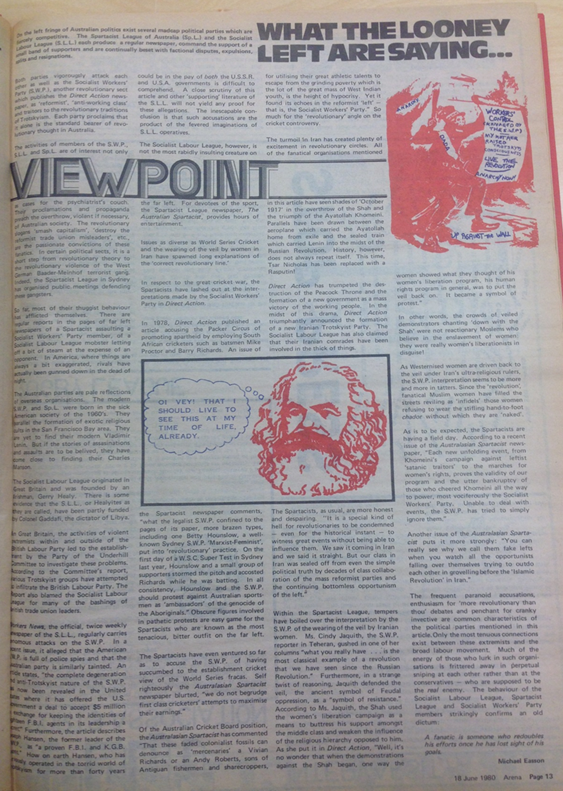
(1980) What the Looney Left are Saying

On the left fringe of Australian politics exist several madcap political parties which are fiercely competitive. The Spartacist League of Australia (SpL) and the Socialist Labour League (SLL), each produce a regular newspaper, command the support of a handful of supporters and are continually beset with factional disputes, expulsions, splits and resignations.

Details →
The article as it appeared in Labor Leader: 1/2

(1980) Comms. Join Forces

On 7th May, the newspapers of Australia’s most influential communist parties, the Communist Party of Australia (CPA) and the Socialist Party of Australia (SPA) carried a joint statement of historic importance and great significance to the labour movement.

Details →
The article as it appeared in Labor Leader.

(1980) Communists Split After Calls for Unity

Since the publication of a joint Statement between the Communist Party of Australia (CPA) and the pro-Moscow Socialist Party (SPA), which promised closer co-operation between these two parties, bitter divisions have emerged between the various personalities and fractions. This article evaluates the significance, reasons behind, and ramifications of the joint Statement.

Details →
Rupert Lockwood

(1980) Rupert Lockwood Remembers

Nearing retirement, Rupert Lockwood plans several books linking the history of his times with his own experiences, ranging from childhood in a German-origin Wimmera community, exclusive private school life at Wesley College, Melbourne – the same school which turned out Robert Gordon Menzies and Harold Holt – to the joining of the Communist Party in 1939, the Petrov Royal Commission, and a three year stint as Tribune correspondent in Moscow.

Details →

(1979) Donald Horne: Almost a Member of the House of Commons

Twenty-five years ago Donald Horne, expatriate Australian, was considering a new career: full time politics as a Member of the House of Commons. The founder of Citizens for Democracy was in 1954 a monarchist and a committed conservative. Had he decided to stand as a Conservative candidate, Donald Horne might today be ‘Donald Horne, Minister in the first Thatcher Ggvernment Ministry’.

Details →
Despite my reservations about Whitlam in government, he was for me and many in my generation a hero who changed Australia for the better. This wallet/purse friendly card was issued in the early 1990s by Andrew West and James Carleton as a whimsical sign of affection. Carleton later edited The Wit of Whitlam, Melbourne University Press, Carlton, 2014.

(1978) The Whitlam Government Reviewed

Much of what has been written since the crushing electoral defeat last year has concentrated on familiar themes, the bias of the media, the issue of the leadership, the real meaning of “socialism”, and so on, rather than tackling the important issue of how the ALP is perceived by the electorate.

Details →