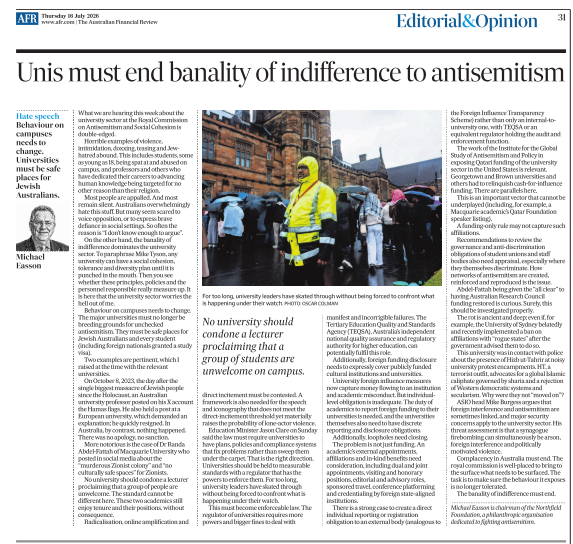
Published on-line in slightly edited form in the Australian Financial Review under the heading ‘Unis must end banality of indifference to antisemitism’ on 15 July 2026. See: https://www.afr.com/work-and-careers/education/unis-must-end-banality-of-indifference-to-antisemitism-20260715-p60fg9. Published in print in the AFR on 16 July 2026, p. 31.
It is double-edged what we are hearing this week about the university sector at the Royal Commission into Antisemitism and Social Cohesion. Horrible examples of violence, intimidation, doxxing, teasing and Jew hatred abound.
This includes towards students, as young as 18, being spat at and abused on campus, and professors and others, who have dedicated their careers to advancing human knowledge, being targeted for no other reason than their ethnicity.
Most people are appalled. And most remain silent. Australians overwhelmingly hate this stuff. But many seem scared to voice opposition, or to express brave defiance in social settings. So often the reason is “I don’t know enough to argue”.
On the other hand, the banality of indifference dominates the university sector. To paraphrase Mike Tyson, any university can have a social cohesion, tolerance and diversity plan until it is punched in the mouth. Then you see whether these principles and policies and the personnel responsible really measure up. It is here that the university sector worries the hell out of me.
Behaviour on campuses needs to change. The major universities must no longer be breeding grounds for unchecked antisemitism. They must be safe places for Jewish Australians and every student (including foreign nationals granted a study visa).
Two examples are pertinent – which I raised at the time with the relevant universities.
On 8 October 2023, the day after the single biggest massacre of Jewish people since the Holocaust, an Australian university professor posted on his X-account the Hamas flags. He also held a post at a European University which demanded an explanation; he quickly resigned. In Australia, by contrast, nothing happened. There was no apology, no sanction.
More notorious is the case of Dr Randa Abdel-Fattah of Macquarie University who posted in social media about the “murderous Zionist colony” and “no safe spaces” for Zionists on campus.
No university should condone a lecturer proclaiming that a group of students are unwelcome on campus. The standard cannot be different here. These two academics still enjoy tenure and their positions, without consequence.
Radicalisation, online amplification and direct incitement must be contested. A framework is needed too for the speech and iconography that does not meet the direct-incitement threshold yet materially raises the probability of lone-actor violence.
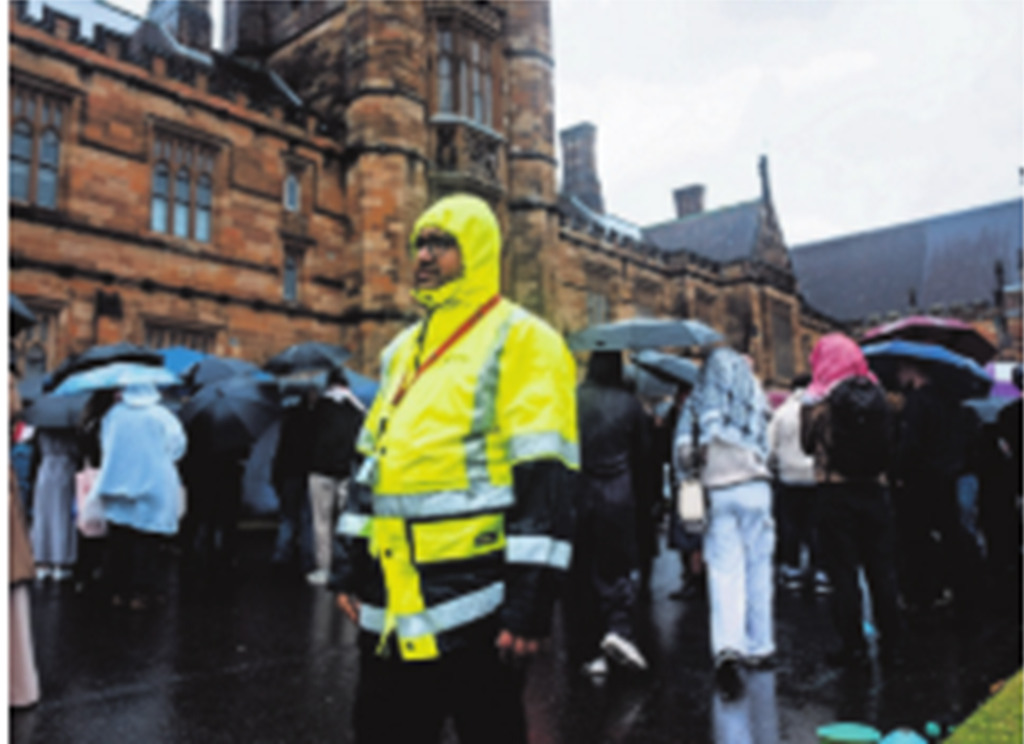
Education Minister Jason Clare said on Sunday that the law must require universities to have plans, policies and complaint systems that fix problems rather than sweep them under the carpet. That is the right direction. Universities should be held to measurable standards, with a regulator that has the powers to enforce them. For too long, University leaders have skated through without being forced to confront what is happening under their watch.
This must become enforceable law. The regulator of universities requires more powers and teeth and bigger fines to deal with manifest and incorrigible failures. The Tertiary Education Quality and Standards Agency (TEQSA), Australia’s independent national quality assurance and regulatory authority for higher education, can potentially fulfill this role.
Additionally, foreign funding disclosure needs to expressly cover publicly funded cultural institutions and universities.
University foreign-influence measures now capture money flowing to an institution and academic misconduct. But individual-level obligation is inadequate. The duty of academics to report foreign funding to their universities is needed and, as well, the universities themselves need to have discrete reporting and disclosure obligations.
Additionally, loopholes need closing.
The problem is not just funding alone. An academic’s external appointments, affiliations and in-kind benefits need consideration, including dual and joint appointments, visiting and honorary positions, editorial and advisory roles, sponsored travel, conference platforming and credentialing by foreign-state-aligned institutions.
There is a strong case to create a direct individual reporting or registration obligation to an external body (analogous to the Foreign Influence Transparency Scheme) rather than only an internal-to-university one, with TEQSA or an equivalent regulator holding the audit and enforcement function.
The work of the Institute for the Global Study of Antisemitism and Policy (ISGAP) in exposing Qatari funding of the university sector in the United States is relevant. Georgetown and Brown universities and others after exposure had to relinquish cash-for-influence funding. There are parallels here.
This is an important vector that cannot be underplayed (including, for example, a Macquarie academic’s Qatar Foundation speaker-listing and association with the Muslim Brotherhood-aligned Center for Islam and Global Affairs at the Istanbul Zaim University in Turkey.)
A funding-only rule may not capture such affiliations.
Recommendations to review the governance and anti-discrimination obligations of student unions and staff bodies also needs appraisal, especially where they themselves discriminate. How networks of antisemitism are created, reinforced, and reproduced is the issue.
Abdel-Fattah’s being given the “all clear” to having Australian Research Council (ARC) funding restored is curious. Surely, this should be investigated properly.
The rot is ancient and deep – even if, for example, USYD belatedly and recently implemented a ban on affiliations with ‘rogue states’ after the government advised them to do so.
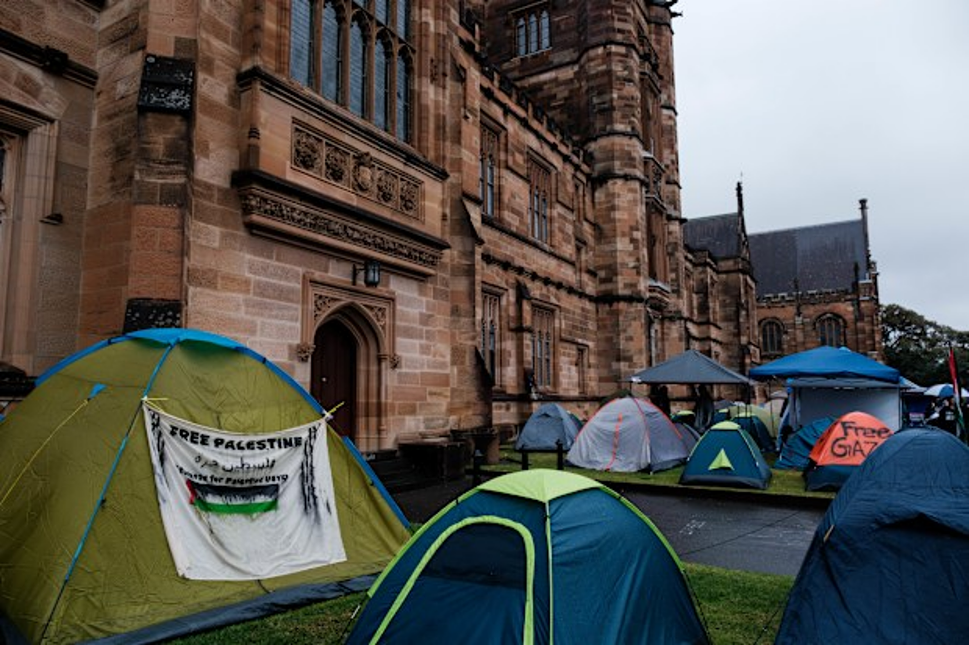
This university was in contact with police about Hizb ut-Tahrir’s (HT’s) presence at noisy university protest encampments. HT, a terrorist outfit, advocates for a global Islamic caliphate governed by Sharia law and rejection of Western democratic systems and secularism. Why were they not ‘moved on’?
ASIO head Mike Burgess argues that foreign interference and antisemitism are sometimes linked, major security concerns apply to the university sector. (His threat assessment is that a synagogue firebombing can simultaneously be arson, foreign interference, and politically motivated violence).
Complacency in Australia must end. The Royal Commission is well placed to bring to the surface what needs to be surfaced. The task is to make sure the behaviour it exposes is no longer tolerated.
The banality of indifference must end.
*Dr Michael Easson AM is Chairman of the Northfield Foundation, a philanthropic organisation dedicated to fighting antisemitism.
How the article appeared in print: