
Review of Paul Strangio, The Alchemy of Leadership. Seven Australian Prime Ministers in a Turbulent Twenty-first Century, Melbourne University Press, Carlton, 2026, published in Tocsin, flagship publication of the John Curtin Research Centre, No. 25, July 2026, pp. 28-30.
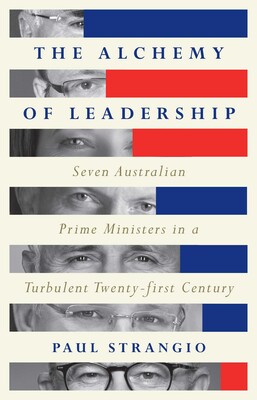
This book is ambitious: to make sense of the eight changes of Australian prime ministers in the first quarter of this century – Howard-Rudd-Gillard-Rudd-Abbott-Turnbull-Morrison-Albanese.
Paul Strangio is no stranger to a challenge. The history from 1856-1956 of that one-time strange laggard, Victorian Labor, is sketched and explained in his Neither Power Nor Glory (2017). His biography of Jim Cairns, Keeper of the Faith (2002), covers the life of the radical socialist cum Deputy PM gone kooky New Age Man after encountering Carl Jung and Junie Morosi.
In a co-written essay on PMs in Understanding Prime-Ministerial Performance (2013), Strangio wrote: “Switching perennially between the front stage and the back stage of politics, in between the community gathering and the international summit, they convene, mediate, broker, persuade, bargain and cajole for a living.” But now he is up-front and personal, no longer opining about PMs at a distance.
Strangio was influenced by University of Melbourne academic Graham Little who sought insights from psychology and psychoanalysis into the passions that animated political life. Little’s Politics and Personal Style, (1973) was pioneering.
Here, Strangio touches on formative influences, difficult fathers (Rudd); absent fathers (Albanese); apparently loving parents (Gillard, Abbott, Morrison); mothers who adored their sons (Howard, Rudd, Albanese); a mother who abandoned hers (Turnbull), and so on. This, for the most part is lightly done. But he says Gillard presents herself “largely behind a forcefield of reserve.”
I am sceptical of how much you can really know about a person and the usefulness of psychoanalysis. Politicians can be complicated beasts. In Henry Fairlie’s classic The Life of Politics (1968) he wryly muses: “…so many of the greatest politicians have seemed to live most happily on the margins of parties, have almost been coalitions in themselves.” Strangio says, “Rudd bought the traces of a damaged individual.” That childhood was hard scrabble, his father harebrained. It is a factor, but not determinative in explaining Rudd PM. Can Strangio be confident when he says of the young, post-university degreed lawyer, John Howard: “Travel did not expand Howard’s horizons.” That point is made by other authors too. But is it true? How would we know?
Strangio says, “It is quite a smorgasbord this alchemy of leadership.” Indeed, as Fairlie says, political leaders are known for “… skill in manoeuvre, management and persuasion.” In preparing this book, Strangio developed “a strengthened conviction that the character and dispositions of leaders are highly determinative of whether or not they prosper in office…” Maybe so. He observes: “Whitlam, Hawke, Keating and Malcolm Turnbull radiated self-love.” Okay. But as Strangio admits, many of “[t]he conclusions drawn are necessarily suppositional and open to contest.”
What is distinctively impressive is Strangio’s analysis of what happened in recent PM history. He explains: “As observed at various points in this book, the dwindling bases of the major parties and the waning attachment of voters to them are simultaneously facilitating a migration of power to leaders while rendering the conditions for governing more volatile.” As the once sure moorings of the major parties are weakened and dislodged, the “philosophical uncertainty of the major parties, dwindling support for those parties and the associated trend towards electoral insurgencies and cannibalisation of voting constituencies…” is readily apparent. These summaries are assured, pithy, true.
There are two politicians, maybe three if you count Albanese, that Strangio is perplexed by.
The first is John Howard, PM from last century through to this, 1996-2007. Howard projected “a populist-hued conservatism aimed at hijacking traditionally Labor-aligned working suburban voters.” Howard was principled, pragmatic, conservative. Even before elected office as a MP, “… he braved university campuses in the second half of the 1960s to argue the case for the Coalition government’s policy of intervention in the Vietnam war.”
There are some other observations on Howard: “…it is not only his longevity in office but the scale of imprint he left on Australia that distinguishes him from his successors.” He surmises: “Howard was a plain-speaking but highly effective and tireless public communicator who exhibited a lawyer’s gift for letter-perfect language. He was an adroit controller of the prime-ministerial institutional machine that he did so much to augment, a methodical executioner of the glamorous tasks of administration, and a supreme manager of cabinet and the party room. The latter were skills he had honed over the years, learning from past mistakes. Howard was also a prime minister of unimpeachable character insofar that venality was not in his make-up.” This is more than grudging respect. It is admiration untinged by political agreement.
In contrast, Abbott and Dutton offered “a crude doubled-down version of Howardism.” Drumming home the point, the two “embodied a kind of supercharged Frankenstein” variant of the real deal. Tellingly, about the charged, ideological posturing of Dutton, Strangio says: “Ironically, one thing his leadership ultimately lacked was the commonsense pragmatism that had been such a recognisable feature of the politics of his hero.”
What explains the lacklustre performance of Howard’s political descendants? Strangio locates this in the internecine warfare between conservatives and small ‘l’ liberals in the party. He also says Howard “unleashed something that was difficult to control.” That is, his populist instincts allowed a complacent, rightward drift within the party. But this analysis is challenged by Strangio’s other observations that Howard’s discipline and pragmatism stood in marked contrast to recent Liberal leaders. He references Howard’s distinctive leadership style: “…its mild-mannered, unaffected presentation and its unthreatening traditionalism.” And he says: “Of course, the absence of the electoral artifice was possible because Howard was being entirely authentic.” The juxtaposition with others, Strangio suggests, represents “a sundering of political reason between him and his descendants.”
Abbott was never popular. But Labor was divided, toxic and chaotic in the Rudd Gillard years. Voters “chose him as their prime minister with a peg on their nose.” Eventually, Abbott’s “…conservative bedfellows abandoned his leadership because of despair at his mismanagement.” Purloining a phrase of Alfred Deakin about George Reid in the first decade of Australian Federation, Strangio says Abbott’s politics comprised a “necklace of negatives”. He never made the transition “from Opposition gladiator to a leader of sympathy governing on behalf of all Australians.” When he said climate change was “absolute crap” he demonstrated his “obliterative potency.” But its appeal withered.
Due to the circumstances of his elevation – tearing down Abbott – and to secure tolerance from the conservatives, Turnbull agreed “to govern in handcuffs.” He did so without characteristic mojo. In 2015, winning by a single electorate, “He was that oxymoronic thing: a sore winner.” He continued to govern “in a straitjacket” until he too was rolled and released.
Morrison is caned for his “secretive leadership unilateralism.” But Strangio is perplexed by how he rose to the top. Brutally, Strangio says: “He was a shapeshifter-cum-chimera, fundamentally transactional and performative… [who] betrayed vacuity, expedience and inauthenticity – something that the Australian public woke up to and rewarded him for.” In case anyone missed the assessment, Strangio refers to “his opaque and elastic political belief system…” Yet here is the thing, as Treasurer under Turnbull, Morrison promoted a rise in the GST, income and company tax reductions. Whatever might be said about the package, this was radical tax reform. His Robodebt scheme, however, was the single greatest act of policy bastardry this century. On Morrison’s book, Plans for Your Good: A Prime Minister’s Testimony of God’s Faithfulness (2024), Strangio says: “Everything about it shouted strangeness.” This is just another way of expressing Strangio’s unfamiliarity with and, perhaps plain bewilderment about, Pentecostal and evangelical strands of Christianity.
Strangio notes that the two most significant policy moves of the 21st century were the National Disability Insurance Scheme under Gillard and AUKUS under Morrison. On the latter, in developing AUKUS his closest advisers were security chief Andrew Shearer, Foreign Minister Marise Payne, and Defence Minister Linda Reynolds – not bad for a man supposedly hostile to working closely with women.
On Labor, after the excitement of Rudd, the party “took refuge in bloodless moderation.” Though “fated as the transformative agent of Australian politics…” with past leaders like Whitlam and Keating who “equated leadership with audacity”, “its leaders [nowadays] have been frequently devoid of the language or imagination to describe its ideological mission beyond the most hackneyed of platitudes.” Strangio explains “Gillard was incapable of parlaying her record of policy achievement into electoral favour.” The cause? “One suspects that part of the explanation for that inarticulateness is that, as with so many of her contemporaries, Gillard issued from the mould of the ‘career’ politician in a professionalised party machine. It is a species of politician that is generally proved lacking in rhetorical (and visionary) range.”
Strangio is cautious about the splintering of two-party dominance “defined and ballasted” by a Labor versus non-Labor political system. He finds refuge in compulsory voting promoted over a hundred years ago which “would ensure that the votes of moderate, respectable citizens balanced those of radical partisans. It would, in short, buttress the political centre.” Australia never falls short of 90 percent turnout in national elections. Of this sizable achievement and its implications, indifference is “emblematic of a winsome national trait.”
He suggests Rudd illustrated the “… perils of image curation and persona shapeshifting.” This alludes to Rudd’s backtracking “on the greatest challenge of our time”, climate change after the Greens, with the Opposition, blocked the government’s green energy legislation in the Senate. Colleagues were spooked. Rudd’s narcissism, rude dealings with colleagues propelled Gillard to a leadership challenge. Rudd worked at frenetic pace. “Howard …initiated a round-the-clock prime ministership, but Rudd accelerated things to warp speed.” Rudd’s apology to the stolen generation stands as his finest achievement. His handling of the economy meant that Australia was one of only three OECD countries to avoid a recession during the GFC.
On the demise of Rudd: “[his] assassins were astonishingly myopic when it came to anticipating the bitter harvest of their actions.” For Gillard: “She had begot a serpent.” Strangio opines that “… continued forbearance to prop up Rudd might have been the wiser course.” Parliamentary colleagues “should have heeded Albanese’s counsel: that ripping down Rudd would destroy two prime ministerships, his and hers.” He reiterates: “Labor removed a first-term prime minister without adequate foresight as to the ruinous ramification for the government and the political system at large.”
As acting PM, Gillard tackled Rudd’s bulky in-tray, shouting as she arrived at work: “Bring out your dead”, all those papers buried, neglected, or lingering for attention. She was an effective administrator in office, but the circumstances of ascension she never recovered from.
On Albanese, in 2022 “…the party’s victory was a loveless one.” So great was the public’s loathing of Morrison. Caution was a by-product “of Labor’s insecure philosophical moorings”, the trauma of the 2019 election loss, and the long shadow of John Howard. Three years later, the 2025 victory rewarded Albanese “for providing stable, grown-up and scandal-free administration after more than a decade of upheaval and delinquency in Canberra.”
Modern Laborites “generally lack the erudition of the voracious autodidacts of the past.” Albanese is almost characterised as an extinct volcano: “The passionate incandescence he generated as a student radical had long exhausted itself, leaving a leader who was amiable and inoffensive rather than magnetic… he resembled Gillard: a leader of stoical hard graft.”
Back to Howard, that figure that haunts the analysis, Strangio says “… throughout this century, Australia has largely lived within John Howard’s political and policy settlement.” The once dominant political brand in Australia, the Liberals, were “a political movement which, although philosophically anchored, put a premium on winning and holding government.” He quotes political scientist Dean Jaensch who called this “liberalism plus pragmatism”. Howard was mostly that, but after winning a majority in the Senate in 2004, “WorkChoices was a deadly exception.” There was hubris before Agamemnon.
Howard is further described as “A quintessential political monomaniac, he was a leader with no off-switch.” In 2001, at a campaign speech, Howard coined the most electrifying slogan of the century: “We decide who comes to this country and the circumstances in which they come.” It carried the day then and arguably also the next election in 2004. He read the Australian public mood well, mostly. “Howard was a prime minister of rare alchemy.”
Strangio concludes that politicians this century “have oscillated between mutiny and meekness.” Rudd, Gillard, Abbott, and Turnbull were deposed by internal revolts. The author worries about “… the eroded bases and diminish philosophical certainty of political parties,” and the potential for inchoate governance ahead.
On Albo, that other perplexing-to-the-author prime minister, the case for the defence is ‘slowly does it’. He sought and failed to convince the public on The Voice. Strangio quotes Max Weber’s view from ‘Politics as a Vocation’ that political temperament and achievement is like the “slow boring through hard boards”. Gradual improvements in workplace reforms, social welfare changes, growing allocations to the education and health sectors are changing society for the better. Relentless application of Labor ideals, evolution of progress, may not be audaciously exciting. Strangio pines for a whiff of the heady days of Whitlam and Hawke: “Perhaps, if he can discover something of the heroic within him, Albanese will one day be counted among them.” But would that be true to character?