
Here follows Daniel Mulino’s speech on Friday 28 August at the Victorian Trades Hall, hosted by the John Curtin Research Centre, followed by my reply.
Daniel Mulino:
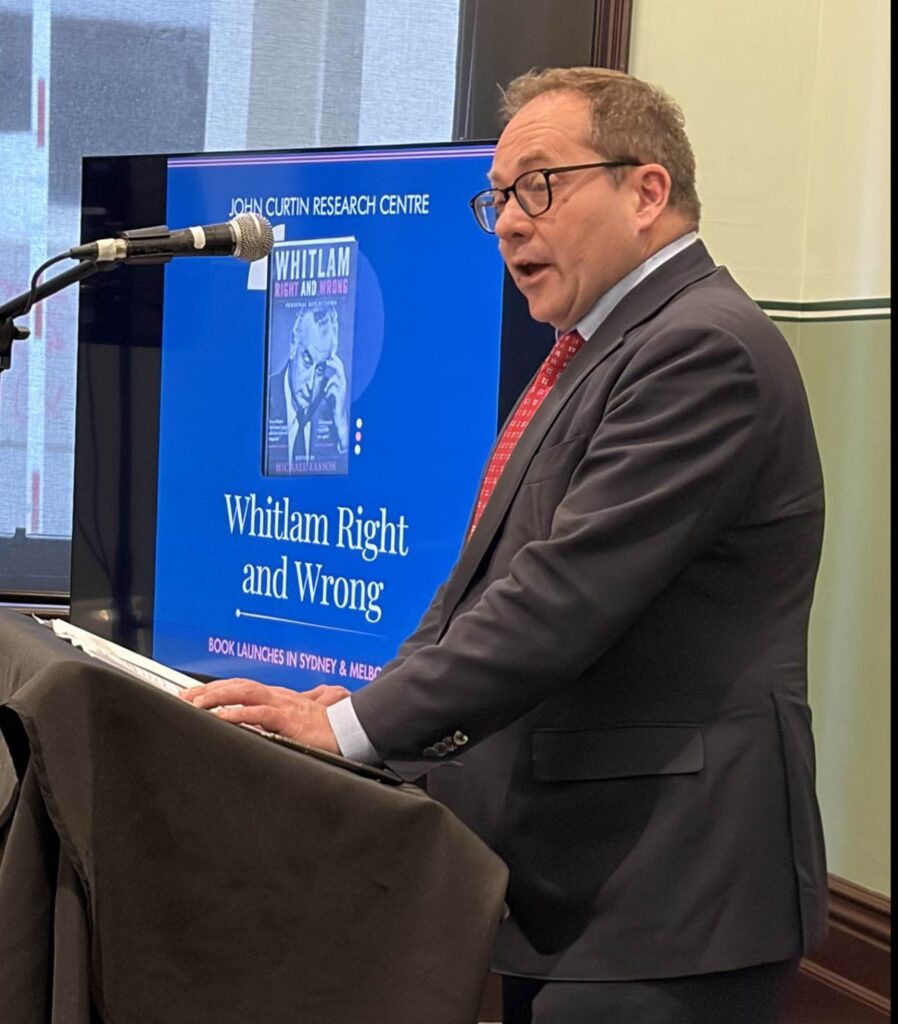
Above and below, Daniel Mulino addresses the crowd in the Balit Mil Room (formerly Meeting Room One) at the Victorian Trades Hall.
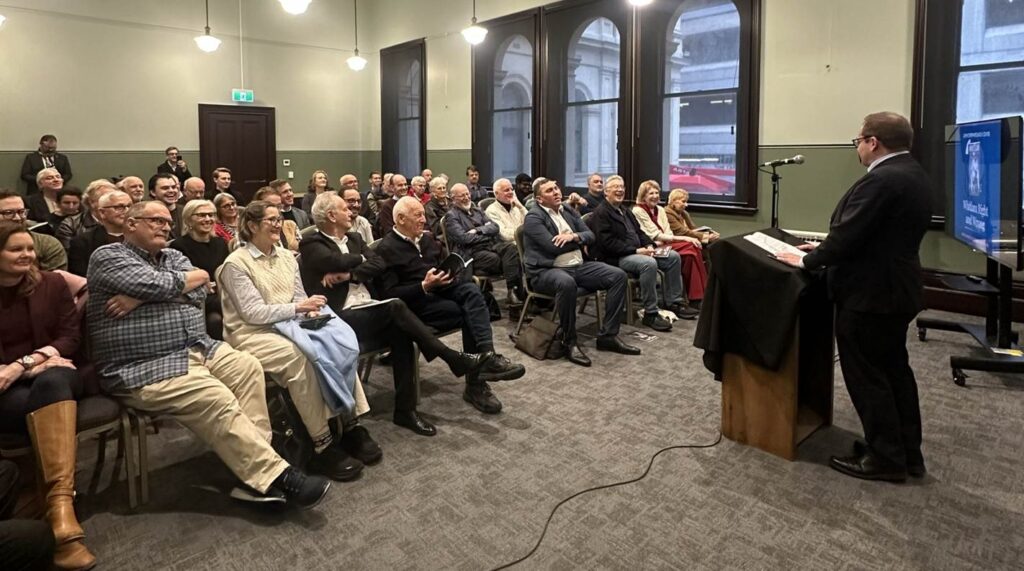
I begin by acknowledging the Traditional Owners of the land on which we meet, and I pay my respects to Elders past, present and emerging.
It is a great pleasure to be with you here at Trades Hall, a fitting place to gather for a book about a government that changed Australia for the better in best traditions of the Labor party and the labour movement.
I am delighted and honoured to have the opportunity to join you today for the launch of Whitlam: Right and Wrong – a title that struck me when I first picked up the book as declaring its purpose with admirable candour.
It is a timely and important contribution to our understanding of one of the most consequential, compelling and contested governments in Australian history.
At the outset, let me acknowledge Michael Easson, whose vision and discerning editorial judgement have brought together a remarkable company of contributors drawn from across the political and intellectual landscape.
I also warmly acknowledge the John Curtin Research Centre and Trades Hall for hosting us.
And thank you to each of you for being here to welcome this thoughtful, provocative and richly illuminating volume.
I must warn you from the outset that this speech will be somewhat Whitlamesque – I wouldn’t claim in its wit – but rather in its lack of brevity. That’s a reflection of how the book has inspired me to think about and reconsider the issues that it raises.
***
Few Australian governments have inspired a literature so abundant, or an argument so enduring, as the Whitlam government.
Its ambition still stirs.
Its achievements still shape daily life.
Its failures still caution us.
And its dramatic end continues to draw historians, participants and political thinkers back into a fierce debate about our Constitution, our political system and our place in the world.
Mindful of the weight of this subject, ahead of today I sought the reflections of several people, including Laurie Oakes, author of the first comprehensive biography of Gough Whitlam, Whitlam PM: A Biography, published in 1973 during the government’s first year in office.
I also returned to the more recent works on my shelves – those of Troy Bramston, Paul Kelly, Jenny Hocking and James Curran – each shedding light on the Whitlam story from a different angle.
And I had the further privilege of also speaking with Gough Whitlam’s sons, Tony and Nick.
I am grateful to all of them.
Their recollections were generous, their judgements candid and insightful, and their reflections were powerful and at times moving.
They reminded me that history is never only a record of institutions and events; it is also carried in memory, loyalty, disappointment and hope.
***
The book we launch here today is a house of argument, bringing views, perspectives and political sympathies under one roof, fitting for a government filled with big thinkers and disparate voices.
Its contributors enter by different doors and occupy different rooms within the political landscape.
They also ask different questions and arrive at markedly different answers.
This is an appropriate structure. A government that still divides opinion more than half a century after its dismissal cannot be understood through a single prism.
Several chapters begin where the government ended – with the constitutional crisis of the Dismissal – and look back through that shattered pane to judge the whole structure.
Ros Kelly and Ian Macphee approach the Dismissal personally, asking how that monumental event shaped their lives and what it revealed about the government it brought an end.
Anne Twomey examines it through the exacting lens of constitutional law: the legality of the key players’ conduct, the alternatives they contemplated, and the paths history might have taken but did not.
Frank Bongiorno and James Watson step back to inspect the wider structure, asking how close Australia came to a social and political rupture more profound than the one that actually occurred.
Other chapters assess the government’s broader record, particular aspects of its contribution and the figures who helped build it.
Michael Forshaw writes about Jim McLelland, an influential minister in the government’s final phase. He traces McLelland’s influence in a contentious portfolio and asks what more he might have achieved had ministerial office lasted longer.
David Kemp, Scott Prasser and Rod Wise each assess the government’s overarching contribution, but from decidedly different vantage points.
David Kemp measures the Whitlam government against the endurance of the Menzies era and concludes that its lasting impact was the lesser. He also traces several of its achievement to legislative and policy foundations laid by earlier conservative administrations.
Scott Prasser writes more personally, through the experience of his family and the pressures faced by a small business in the turbulent economy of the 1970s.
Rod Wise offers the perspective of someone who worked closely with Whitlam on his local campaigns, bringing the texture of political life to the wider historical judgment.
And Michael Easson opens the book with an essay that is far more than an introduction. Even before the volume’s many strands have been fully laid out, he gathers them together and gives us a way of seeing the larger design.
***
Reading these contributions, I experienced a succession of responses: fascination at the personal impact of those heady years; admiration for those whom Whitlam inspired to enter public life, including Ros Kelly; and curiosity about those whom the same government stirred to resistance, and set upon a different political path.
Elsewhere, especially in the chapters evaluating the government’s performance, I found myself sometimes nodding in agreement, at others tensing in dissent. Yet even where I disputed the argument or train of analysis, I kept turning the pages.
That is one measure of the book’s success.
I learned a great deal. That is another.
Importantly, the book forced me to pose my own questions to this extraordinary government.
It unsettled some assumptions, sharpened others, and prompted me to revisit my own assessment.
I came away with four questions; each echoing themes explored in this volume.
The first is historical: where does the Whitlam government sit in Australian history?
The remaining three questions relate to the sterner test of performance.
- What was its long-term legacy from its 1,071 days in office?
- Which reforms were unwound before they could take hold?
- And how capably did it manage the issues and crises that arose on its watch?
***
For me, it is first important to place the Whitlam government within a broader context. I believe the election of the Whitlam government in 1972 was a key turning point in Australian history.
Its election was not merely a change in government. It was a national threshold – the moment Australia stepped from one political age into another. Paul Keating put it memorably: “There was an Australia before Whitlam and a different Australia after Whitlam.”
Politically, the 1972 election was a pivot. Whitlam ended 23 years of conservative rule. He was the first ALP leader to win back government from the conservatives since the Second World War. But perhaps even more importantly, the election was a turning point within Labor itself – a transformation in the sophistication of our party’s policy, and the breadth of our ambition, and the pragmatism of our politics.
To understand this transformation, we need to stand back and examine the whole structure.
The Whitlam government occupied the Treasury benches only briefly. But the foundations of Whitlam’s victory had been laid over many years, through the long labour of opposition. For more than a decade, Whitlam had helped to rebuild Labor. He forged policy coherence, established credibility abroad, challenged sacred cows, and, above all, made Labor electable.
***
Whitlam served as Deputy Leader from March 1960 until February 1967, years in which he was already becoming one of Labor’s principal architects of policy. He spent more than five and a half years as Leader of the Opposition in the leadup to the election of December 1972, with both a determination to change Australia and a formidable program for doing so.
In talking to Laurie Oakes this week, he told me that he was at Sydney’s Sunnbrook in Cabramatta with Gough and his staff, two blocks from the Whitlam home, as the votes came in that night. Oakes recalled the moment when a person working the numbers suddenly realised Labor had won. Turning to Gough, he said: “I think we can send the white smoke up the chimney now.” I’m confident that Gough wouldn’t have disagreed with the analogy.
Three years earlier, in 1969, he had led Labor to a powerful electoral recovery, erasing much of the Coalition’s advantage and bringing government within reach. Those 12 and a half years in opposition, as Deputy Leader and then Leader, were a transformative marathon: a long schooling in policy, persuasion and party reform.
The years in office from 1972 to 1975 were a whirlwind. But to view those years in isolation is a mistake in my view. Many of the government’s defining policies were not born in that turbulence. They had been meticulously conceived, tested and refined long before.
Consider Medibank. Its arrival was preceded by years of rigorous development, advocacy and political contest. As early as July 1967, Whitlam had met the prominent health economists John Deeble and Richard Scotton. From that encounter began a sustained and exacting process of policy design. In 1968, despite resistance within his own party, Whitlam shifted Labor from a British-style National Health Service, otherwise known as the ‘NHS’, towards a universal insurance model.
The financial architecture developed in 1968 and 1969 centred on a universal insurance model, direct billing by doctors and a proposed levy in income. The levy was proposed at 1.25% at the 1969 election and ultimately set in the legislation at 1.35% on taxable income, with exemptions for low-income earners. But the result was more than an expert-designed health policy. It also embodied a major act of political adaptation and pragmatism by the Labor Party itself and became a centrepiece of Whitlam’s 1969 campaign.
When the Whitlam government finally brought Medibank into being, it was not building from the bare ground. It was completing a design refined over many years and advocated across successive elections.
The same was true of needs-based education funding and the proposed Australian Schools Commission, both endorsed at successive Labor National Conferences in 1969 and 1971. This was not merely a policy development. It marked a profound political departure away from Labor’s previous long and rigid opposition to public funding for non-government schools.
Nor were these isolated examples.
In foreign policy, Whitlam was imaginative, forward-looking and prepared to incur domestic political risk. His visit to China as Opposition leader was the clearest expression of that approach. He was vindicated in arguing that Australia should recognise the People’s Republic of China. His 1971 visit preceded President Nixon’s public announcement of his own intended journey to Beijing, leaving the McMahon government flat-footed and exposed.
That stance, too, rested on years of thought, advocacy and careful positioning.
Whitlam would ultimately lead the federal parliamentary Labor Party from February 1967 until December 1977, an almost eleven-year tenure whose length is often obscured by the brevity of his prime ministership. For more than 17 years he was either Leader or Deputy Leader of Federal Labor.
The 12-and-a-half years before 1972 matter most to my argument. They were the long apprenticeship in which he prepared Labor for office and developed and shaped the policies that would define its legacy.
The significance of 1972, then, lies in more than Labor’s return from a long political wilderness. It was also the crossing of a threshold: the moment when years of patient preparation entered the rooms of power. It marked Labor’s reinvention as a modern governing party.
Labor entered office with serious, sophisticated policies in foreign affairs, health, education and economic management – policies shaped by years of work, sustained by a willingness to compromise that the party had too often resisted, and guided by Labor’s north star of fairness.
The answer to my first question – Whitlam’s place in Australian history – is that only in a broader perspective can its turbulent three-years in office be properly judged. It is three years that forms part of a decade of policy development and institutional renewal.
***
The second broad question is how the Whitlam government performed. The familiar verdict begins with admiration and ends with a qualification: “it achieved so much – but …”
The government rebuilt much of Australia’s public life in ways that endured, yet governed with a disorder that sometimes obscured, and at times weakened, its achievements. This is one of the book’s central questions, and many of the contributions provide varying assessments.
I believe that evaluating the government’s record becomes clearer when we distinguish three separate tests:
(1) What legislative and policy achievements have stood the test of time?
(2) What reforms faltered because the government’s life was so brief?
(3) How capably did the government manage issues and crises that arose during its term?
***
The first answer is well known. It is the rollcall of reform; what Noel Pearson memorably framed as the Australian version of “What have the Romans ever done for us?
Its reach extended across almost every field of government:
- Medibank;
- Needs-based school funding;
- The Racial Discrimination Act and major advances towards land rights;
- The Commonwealth’s support for equal pay for work of equal value, advancing equality for women;
- In economic policy: enacting the Trade Practices Act, tariff reductions and creating the precursor to today’s Productivity Commission;
- the lowering of the voting age;
- the end of conscription;
- the removal of the remaining discriminatory practices associated with the White Australia Policy;
- the establishment of legal aid; and
- No-fault divorce
And even that formidable list is not exhaustive.
As I noted earlier, some of its most complex reforms, Medibank and needs-based education among them, were not improvised in office. They were the culmination of years of work, argument and political preparation; several had already been placed before the electorate in 1969.
Others took shape only once the government was in office. What is in many ways remarkable was how many major legislative reforms were passed, particularly given: obstruction in the Senate from the Coalition and the DLP; the persistent efforts of states to challenge the constitutionality of legislation in the high courts; virulent negative coverage in the media; and sustained and bitter opposition to some reforms from powerful stakeholders.
The essential point is that many – arguably most – of those achievements have become part of the civic architecture within which Australians live each day.
They live in the patient who can see a doctor without first fearing the bill. They live in the woman whose path to university and equal pay was widened. They live in the outer suburban family given access to basic services, including sewerage, and a fairer chance to flourish. That, to me, is the most exacting test of government: whether it can turn conviction into policy design, design into law, and law into a better and more secure life for people it may never meet.
By that standard, the Whitlam government stands tall among the most successful reforming administrations.
***
The second question is more difficult: which achievements failed to endure?
Some reforms were implemented, only to be weakened or unwound under the Fraser government. Medibank’s universal character was progressively dismantled. The momentum behind needs-based funding slowed. The Australian Legal Aid Office was decentralised, altering the national character of Whitlam’s original design. Medibank stands out because it reveals the vulnerability of a reform whose foundations had been laid in law but whose place in the national consciousness was not yet secure.
Labor, under Whitlam, deserves immense credit for conceiving, developing, championing and ultimately delivering universal health insurance. Yet Medibank arrived only after the 1974 election, against ferocious stakeholder opposition and while the government itself was fighting for its survival. It had scarcely begun to enter ordinary life before the Fraser government was able to dismantle its universal character.
Contrast this with Medicare. Introduced in February 1984, it took hold at the start of a period of 13 years of Labor government. By the 1996 election, John Howard had committed the Coalition to retaining it. A reform once bitterly contested had become part of the national settlement. That durability was only possible because the Hawke and Keating governments won five consecutive elections.
Great reforms require more than passage through Parliament. They need time: time for their foundations to settle, time for people to inhabit and experience them, and time to become so familiar that they cease to seem like additions to the national house and are accepted simply as part of its structure.
***
The final element of the government’s record concerns not the grand design, but the daily burden of keeping the house in order – responding to events and crises no blueprint can fully anticipate.
When asked what the most troubling aspect of his prime ministership was, Harold MacMillan is attributed by some as having responded with four words: “Events, dear boy, events”. Churchill expressed much the same thought in 1919, “The only opposition we have to encounter is the opposition of events.”
The Whitlam government encountered many such events. Economically, the most consequential was the first oil shock. Its scale is difficult to overstate. It reordered geopolitics, convulsed energy markets and destabilised the macroeconomic assumptions on which every advanced economy had relied. Beginning in October 1973, the price of crude oil jumped from roughly $3 to around $12 a barrel. In a matter of months, the cost of our economy’s essential energy input had quadrupled.
The immediate effects were shortages and price spikes. The deeper effects were slower growth, surging inflation, falling productivity and wage-price spirals whose force differed according to each nation’s energy dependence, industrial structure, economic flexibility and industrial relations institutions. Across the OECD, governments confronted different combinations of recession or slower growth, productivity decline and wage-price pressure. The precise severity varied with national circumstances. Australia suffered grievously, but it did not suffer alone.
The fair historical question, then, is not whether Australia suffered. We plainly did. The question is how well the Whitlam government managed an upheaval that shook every advanced economy.
Detractors argue that the government magnified the economic shock in three ways: by allowing Commonwealth spending to rise too rapidly as a share of GDP; by contributing to the wage-price spiral; and by tolerating serious haphazard management of process, most notoriously in the Khemlani loans affair.
Its defenders reply that Australia’s broad macroeconomic performance remained within the range, or in the “pack”, of advanced economies: hardly exemplary, but by no means uniquely disastrous.
I do not propose to settle that complex economic argument here.
I would concede that some of the government’s decisions in real time may not have been ideal, particularly in relation to the more complex and dynamic issues that they faced. At times, the government was indeed chaotic. But in relation to the economic turmoil of the early 1970s, what must not be forgotten is that the Whitlam government neither caused the oil shock nor struggled alone in its aftermath.
Rigorously assessing the government’s performance requires more than pointing to deteriorating economic indicators. It requires careful analysis, comparison, proportion and judgement. Too often, the worsening conditions that followed the oil shock have been treated not as context to be analysed, but a shorthand verdict on the government’s competence.
***
I have posed three tests of the government’s performance.
On the first, its long-term legacy, the record is formidable. Yet two qualifications remain, arising from the second and third tests. Some major achievements, Medibank foremost among them, did not survive intact. It’s later rebirth in Medicare underscores the point: the government did not remain in office long enough to defend those reforms, entrench them and make them politically untouchable.
Nor was its management of events as assured as its capacity for thinking creatively and deeply about systemic change. Perhaps that is because it had spent so long preparing the great architecture of reform. Perhaps some senior ministers had waited too long in opposition and entered office at the wrong point in their political lives to master the relentless improvisation that governing demands.
The late rise of Hayden, McLelland and Keating leaves an unavoidable counterfactual: might the government have been more agile had some of its younger talent assumed central responsibilities sooner?
My judgement, like that of almost every commentator before me, is mixed. This volume has made it a more considered mixture: less certain in some places, firmer in others, and more attentive to the distance between aspiration, achievement and endurance.
It was, as Ros Kelly so eloquently shows, a government that awakened political possibility in countless Australians, persuading many that public life could be larger, fairer and more generous than they had previously imagined.
It was also a government whose remarkable, and so often original, achievements sometimes extended lines of policy begun by its conservative predecessors, as David Kemp observes, although I diverge, not unsurprisingly, from his broader verdict. And it was a government that promised still more than it delivered – an unfilled possibility captured in Michael Forshaw’s account of Jim McLelland’s brief ministerial impact.
**
When I weigh what failed against what endured, I return to my central proposition: the election of 1972 was not simply a change of government. It was a change in the scale of possibility – in what government might attempt, whom it might lift, and what the nation might dare to become. It is a lesson that is at once inspiring and sobering.
Ambitious, nation-changing reform is possible, but it is never self-securing. Reform must be defended long enough to be trusted, embedded long enough to become indispensable, and governed wisely enough to survive the events that history sends without warning.
***
Many of the chapters in this book begin with the end, looking back through that broken window of the Dismissal at all that came before. Let me finish with the end – not because the ending explains everything, but because its shadow still falls across the administration and our nation’s history.
The Dismissal matters in its own right: as a constitutional crisis, as a political rupture and as a democratic trauma. It was also political theatre of an intensity Australia must hope never to witness again. But its deepest significance lies beyond the drama.
For many Australians, the enduring wound was not simply that a government was removed before an election was formally due. It was that a particular vision of Australia – a more equal, more confident, and outward looking national home – had been left unfinished. A government impatient with inherited limits. A government willing to spend political capital on enlarging citizenship, widening opportunity and remaking the institutions of national life. A government flawed in execution, but audacious in design, and unfinished in possibility.
That is why the Dismissal gives the questions running through this volume their enduring ache – and their continuing urgency.
What was lost when this government ended? What did it leave behind? And which of its unfinished possibilities still speak to us – still calls us forward? This volume does not offer the comfort of a final verdict. That is a strength.
It offers something more valuable: the invitation to look again.
To separate achievement from mythology, failure from caricature, memory from judgement. To see more clearly the Australia we inherited and the Australia we might yet become.
In doing so, I believe it returns the Whitlam government to us not as a relic sealed away in 1975, but as a living argument—one that continues to speak to courage and power, to reform and endurance, and to the kind of country we owe to one another.
It is, ultimately, a reminder of a nation we must still have the courage to imagine, and the resolve to build.
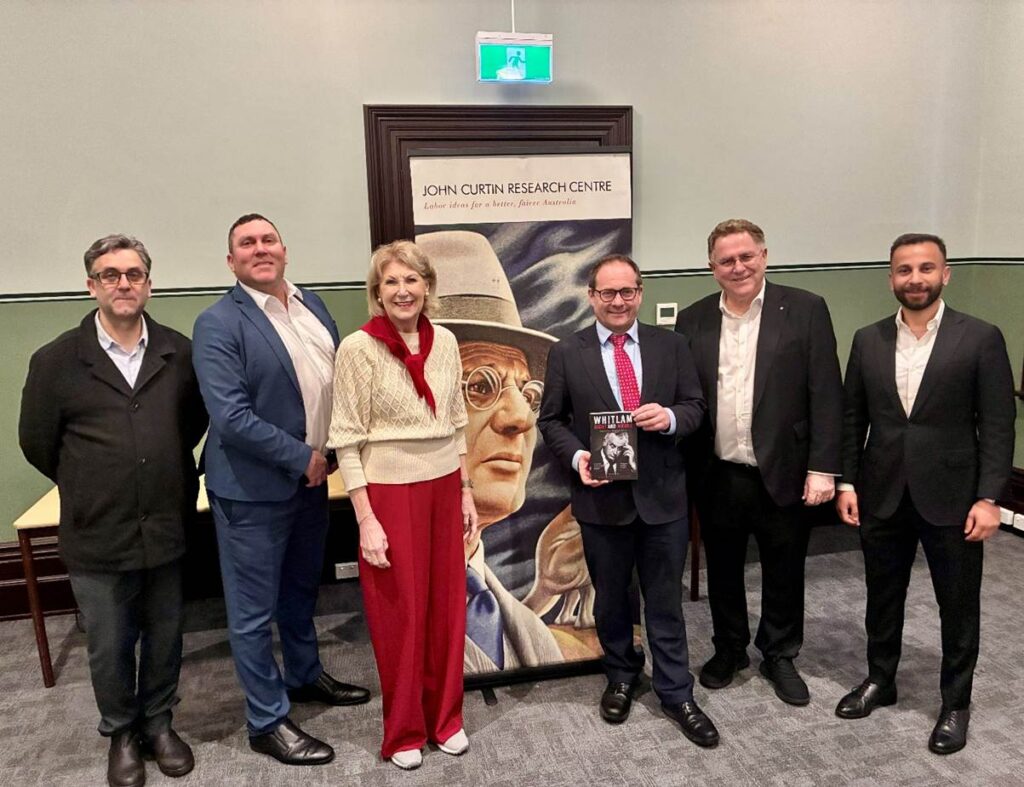
Michael Easson’s Remarks in Response:
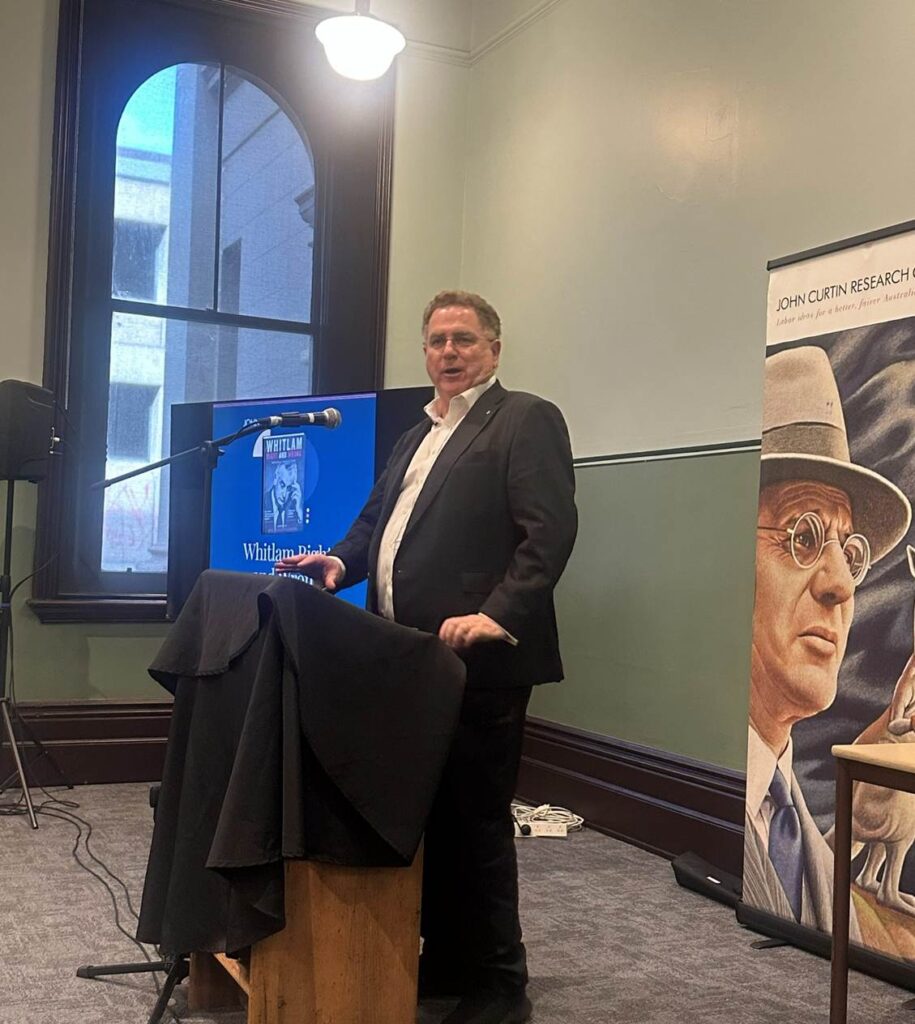
I’ll be very brief, because how can anyone match what Daniel has just said? It made the book worth publishing just to hear that speech.
The reason for the book is that an email lobbed into the publisher’s inbox from a “ghost”, Rod Wise, who had been the (honorary) Federal Electorate secretary of Gough Whitlam up until 1977. He lost a preselection [Werriwa in 1978] and eventually left the Labor Party, and he joined the Australian Financial Review.
Years later — and I hadn’t seen him for almost 40 years — he wrote this essay, “Memoirs of a Labor Has-Been”. It ended up in Anthony Cappello’s inbox, and he contacted me and Anthony, the publisher of Australian Solidarity publications, said “How about you put a book together of different authors giving a perspective on the Whitlam government?” He urged, “please find people who are not the usual contributors.” Hence, we now have the very different authors in this collection, somebody talking about how Whitlam’s government almost destroyed his family business; David Kemp compares Menzies with Whitlam, comparing Menzies more favourably, Anne Twomey on Kerr & Whitlam’s brinkmanship, and all the other Labor people who contributed to giving a perspective about Whitlam.
The one thing they all agree on is that Whitlam mattered. What we’ve just heard from Daniel is an exposition as to how, in its various manifestations, that description is absolute.
I joined the Labor Party because of Whitlam. He inspired me. And I’m forever grateful for a bored Country Party-voting teacher at my local Catholic school. He [Mr Ford] decided one time when I was in third form (Year 9), to ask, “Who here is Labor?” Half the hands went up. “Who here is Liberal?” Four hands went up. “Who here is Country Party?” No hands went up. “Who here is DLP?” The rest of the class put their hands up. And he said, “You, you, you, you’re going to defend your choice next week.” And I had to defend why I supported Whitlam. I began teenage life as a dewy-eyed Whitlamite. But I know that’s not the end of how any assessment should be of Whitlam. I would like to thank all the contributors to the book.
I’d like to thank everyone who has already bought a copy of the book. And please, if you haven’t, there’s still some more left over. And Anthony doesn’t want to bring any of them back to Brisbane, where he lives. Please do him a favour. I would especially like to thank everyone for coming along to this book launch. I’m sure Daniel Mulino was more the drawcard than me. But, if you read the book, I think you’ll be pleased by a great read.
And I’m very glad we found 50 photos like this one here, the front cover, taken by a fellow called Bill McAuley on the day Whitlam was dismissed. You can see in that portrait all the emotion that must have been running through his mind at that time. My favourite photo is at the beginning of Anne Twomey’s chapter on Whitlam and Kerr and how they were gaming a strategy before the dismissal occurred. That’s the photo where Kerr is speaking at the Rugby League Grand Final in 1974, and the winning captain, Arthur Beetson, is thinking – forgive the language – “When the f**k are you shutting up?” And that’s probably a good cue for me here and now to stop.
Thank you all.
A video of some of what was said is here: