
Published on-line in the Australian Financial Review on 6 July 2026 in edited format under the heading ‘Can the CFMEU kill off its gangster culture?’; published in print under the heading ‘CFMEU Must End Gangster Culture’ on 7 July 2026, p. 30.
“How can you vote Labor given the CFMEU shenanigans?” You hear this a lot in Victoria. Geoffrey Watson SC in a review of cost blowouts in Victorian government-funded projects alleged the Victorian branch of the Construction Forestry Mining and Energy Union (CFMEU) descended into a “violent, hateful and greedy rabble” under former CFMEU state boss John Setka.
There are calls for a Royal Commission into Big Build and other cost-blowout disasters in infrastructure delivery in Victoria.
Both factors imperil the Victorian Labor government. Even a divided Liberal-National Opposition looks set to govern after elections this November because of Labor’s failures. These include the Victorian government’s inaction when the union turned into a crime syndicate.
Watson’s report delivered in September 2024 is not easily dismissed. He was commissioned by the labour law firm Maurice Blackburn on behalf of the then Federal Office of the CFMEU.
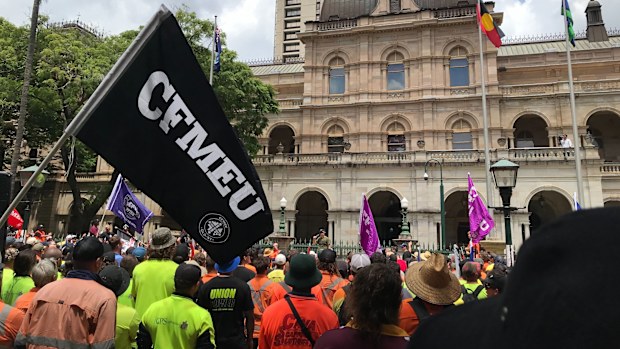
2015 and 2024 cost Victorian taxpayers about $15 billion. Photo credit: William Davis
Watson estimated that actions of the CFMEU between 2015 and 2024 cost the Victorian taxpayer around $15 billion. In a redacted part of his report, subsequently widely reported, Watson found: “Much of that $15 billion [was] poured directly into the hands of criminals and organised crime gangs.”
The union transformed from pioneers and innovators for working class Australians in a tough industry to a violent mob-linked enterprise that “cultivated the company of underworld figures” and bikie gangs.
Given that assessment, is such an organisation worth ‘saving’?
First, a brief history of how we got here. Corrupt, reckless and erratic behaviour has been endemic in Australia’s building industry for decades. The old Builders Labourers Federation (BLF) led the way into disrepute. The BLF was deregistered by the Hawke government in 1986.
But like slime, their influence through ex-officials and culture permeates the industry.
The old Building Workers Industrial Union (BWIU) was a tough-minded largely corruption-free outfit, led by pro-Moscow communists, rivals to the BLF. Despite their views on international affairs, BWIU officials were generally principled, mindful militants. A deal was a deal. You could rely on their word.
The BLF was led by pro-Maoist ‘cultural revolution’ communists, who thought stealing from the boss, defying court orders, stopping concrete pours, was part and parcel of the revolutionary struggle against capitalism. It was more anarchist than anything else, and for decades they sought connections with criminals to enforce their ‘rule’ over building sites.
The old Amalgamated Society of Carpenters and Joiners, significant in Victoria, was a rival to the BWIU, mostly led by Catholic anti-communist unionists.
Other, smaller, craft-oriented building unions were moderate Labor in outlook.
By the early 1990s, under the ACTU union amalgamation strategy, all were swept into a single union, the CFMEU, formed in 1992.
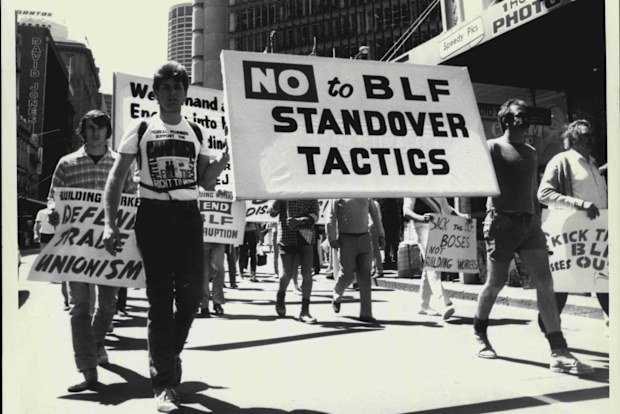
1974, protesting about Builders Labourers Federation tactics and corruption. Credit: Bruce Milton Miller.
The demise of the principled communists and the old Catholic-action types is related to how the union changed hands. The BLF-aligned elements took over Victoria, had supporters in Western Australia and Queensland, and eventually captured the national office. A bitter internal conflict led eventually to corrosive corruption.
The Construction and General Division of the CFMEU was placed into administration in August 2024, with the administrator Mark Irving KC in charge. A few years ago, sections of the union in forestry, manufacturing and mining, broke away to form independent organisations. Irving appointed state administrators. He resigned last month and the person he appointed to run the NSW branch, Michael Crosby, took over nationally.
Generally, Royal Commissions are incredibly expensive, take too long to deliver findings, which are subject to the changing whims of the political cycle.
Is the CFMEU administration strategy likely to be successful? So far, it has plausible credibility. The ACTU called for administration. Its purpose is quite clearly reform of the union.
In the last 18 months administrators have removed a whole generation of corrupt, violent leaders from the union. Setka and his ilk are gone. NSW fired nearly every official. Previous leaders have been convicted of offenses, as have some corrupt fixers in labour hire and other pockets of the industry.
What is apparent from previous efforts to wipe out corruption over the last forty years including Royal Commissions (Gyles in NSW, Heydon, federally, etc) is that change needs to be systemic, grassroots-oriented, and ruthless. Otherwise, the slime creeps back.
The CFMEU administrators hired new teams of organisers who are being, for the first time, properly trained in how to do their job. Crosby, a veteran union leader, is instituting a culture of total and utter contempt for corruption. He is pointing the union, new officials and delegates to a commitment to the lawful exercise of collective power. Part of this is to refocus on a core objective – safety on construction sites. Crosby and his team aim to build a powerful, honest and principled union.
This is vastly different from the raw aggression and muscle previously projected. The old slogans on union merchandise and publicity were what you might see at a bare-knuckle boxing event or in a bikie club. It was very much influenced by Setka, the dominant force in the Construction Division and whole union.
This imagery of intimidation and latent violence did not start with Setka. Its genesis was in the confronting Maoist slogans of Gallagher’s BLF in the 1970s and 80s. The BLF’s iconography took a turn for the worse with the creation of the hard hat sticker with the words “If provoked we will strike” and the menacing Cobra snake. The imagery degenerated further with skeletons and skulls featuring on union shirts alongside threatening slogans.
That is no longer a feature of CFMEU ‘merch’.
There is a need for everyone to share the responsibility – to show conspicuous, steadfast and ongoing leadership.
It is not only the union that matters. All major participants in the building and construction industry must actively contribute to eradicate corrupt conduct. This includes tier-1 builders, their clients and funders, major contractors, employer associations, other unions, law enforcement agencies and regulators, in addition to states and Commonwealth governments.
The jury is still out on the CFMEU administration. It cannot last forever. We will then find out if the foundations are secure or if the slime finds its way back.
*Over thirty years ago, Michael Easson was a Vice President of the ACTU. He wrote a PhD thesis at Melbourne University on transport project delivery.