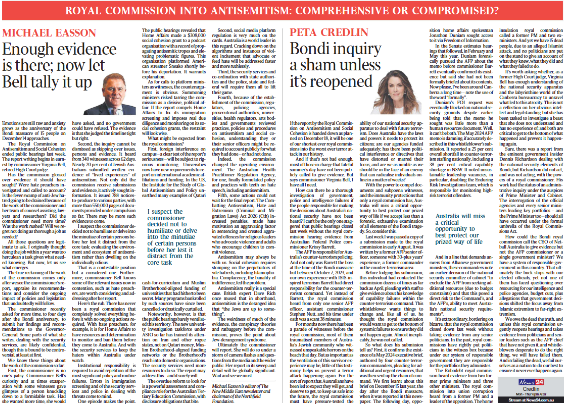
Published in The Australian newspaper under the heading ‘Enough Evidence is There; Now Let Bell Tally It Up’, 3 September 2026, p. 13.
Emotions are still raw and anxiety grows as the anniversary of the Bondi massacre of 15 Australians on December 14th approaches.
The Royal Commission on Antisemitism and Social Cohesion ended public hearings last week. The report writing begins in earnest by Commissioner Virginia Bell, retired High Court Judge.
Has the Commission glossed over evidence it should have sought? Were hate preachers investigated and called to account? Is the fever swamp of anti-Jew hatred going to be drained because of the work of the Commissioner and her team of counsel assisting, lawyers, and researchers? Did the Commissioner need more time? Was the work rushed? Will we regret not doing as thorough a job as needed?
All those questions are legitimate to ask. I originally thought doing the job within a year was too Herculean a task given what needed knowing. But now, let us see what emerges.
The true reckoning of the work of the Commission only comes after we see the Commissioner’s report, appraise its recommendations and consider the ongoing impact of policies and legislation that undoubtedly will follow.
The Commissioner recently asked for more time, to four days after the Bondi anniversary to submit her findings and recommendations to the Governor-General. Some parts of what she writes, dealing with the security services, are likely confidential, though this is bound to be controversial, at least at first.
We know these things about the work of the Commission so far:
First, the Commissioner is no one’s patsy. Commissioner Bell’s curiosity and at times exasperation with some witnesses gave glimpses of a person knuckling down to a formidable task. Had she wanted more time, she would have asked, and no government could have refused. The evidence is that she judged the timeline tight but right.
Second, the inquiry cannot be dismissed as skipping over issues, persons, and evidence. It heard from 340 witnesses over 62 days. Nearly twenty percent of Jewish Australians submitted written evidence of “lived experiences” of antisemitism. Not only did the Commission receive submissions and evidence it actively sought information. It issued 788 notices-to-produce to various parties, with more than 550,000 pages of documents provided under compulsion so far. There may be more such evidence to come.
I suspect the Commissioner decided not to humiliate or delve into the minutiae of certain persons before her, lest it distract from the core task: evaluating the environment and ecosystem of antisemitism, rather than dwelling on the individually odious. That is a contestable position, but a considered one.
Furthermore, Commissioner Bell knows that some of the relevant issues now in contention, such as hate preachers, are worth considering and addressing after her report.
Here’s the rub. There has never been a Royal Commission that completely “solved” everything before it with no on-going actions required. With hate preachers, for example, it is for Home Affairs to have resources and determination to monitor and ban them before they come to Australia. And with the security services to keep the haters within Australia under watch.
Institutional responsibility is required to avoid repetition of the most significant policy and routine failures. Errors in immigration screening and of the security services and police in dealing with threats come to mind. One episode makes the point. The public hearings revealed that Home Affairs made a $308,000 social cohesion grant to a podcast organisation with a record of propagating antisemitic tropes and elevating problematic figures. This organisation platformed the American streamer Sneako shortly before his deportation. It warrants explanation.
As for calls to platform ministers as witnesses, the counterargument is obvious. Summoning ministers risked tarring the Commission as a divisive, political affair. If the report compels Home Affairs to fix its immigration screening and imposes real due diligence and monitoring on its social cohesion grants, the restraint will look wise.
What might be expected from the Royal Commission?
First, foreign interference on campus — a clear test of the report’s seriousness – will be subject to rigorous monitoring. Universities now have new requirements to report on international academic affiliations and funding. In the United States, the Institute for the Study of Global Antisemitism and Policy unearthed many examples of Qatari cash-for-curriculum and Muslim Brotherhood-aligned funding of universities, which had hitherto been secret. Many programs bankrolled by such sources have since been cancelled or drastically curtailed.
Noteworthy, however, is that the public hearings barely ventilated this territory. The new university investigation taskforce under ASIO has so far trained its attention on Iran and other rogue states, not on Qatari money, Muslim Brotherhood-aligned funding networks, or the Brotherhood’s reach into domestic organisations. The security services need more resources to do so. The report may address this — and it surely will. The overdue reform to look for is a powerful assessment and compliance role for the Australian Tertiary Education Commission, with disclosure obligations that bite.
Second, social media platform regulation is very much on the cards. Australia is a world leader in this regard. Cracking down on the algorithms and instances of violent incitement that advocate or feed hate will be addressed faster and more ruthlessly.
Third, the security services and coordination with state authorities and the police, state and federal, will require them all to lift their game.
Fourth, because of the establishment of the Commission, regulators, policing agencies, prosecutorial authorities, universities, health regulators, arts bodies and governments reviewed practices, policies and procedures on antisemitism and social cohesion, understanding they or their senior officers may be required to account publicly for what they had done – or had not done.
Indeed, the Commission changed the operating environment. The Australian Health Practitioner Regulation Agency, for one, finally formulated policy and practices with teeth on hate speech, including antisemitism.
Fifth, some actions could not wait for the final report. The Combatting Antisemitism, Hate and Extremism (Criminal and Migration Laws) Act 2026 (Cth) increased penalties, made hate motivation an aggravating factor in sentencing, and created aggravated offences for religious leaders who advocate violence and adults who encourage children to commit violence.
Antisemitism might always be with us. Social cohesion requires stomping on the perpetrators of vile hatreds, including Islamophobia. Complacency, the banality of indifference, fed the problem.
Antisemitism really is a special case. The UK expert Dave Rich once mused that in shorthand, antisemitism is the deranged idea that “the Jews are up to something.” The weirdness of much of the evidence, the conspiracy theories and ratbaggery before the Commission proves the point about Jew-derangement syndrome.
Ultimately the Commissioner will report. She will do so under a storm of camera flashes and questions from the media and the wider public. Her report in its sweep and detail will be globally significant. Wait and see we must.
The article was meant to state: “Dr Michael Easson AM is editor of The New Middle East Newsletter & Chair of the Northfield Foundation. This piece is written in his personal capacity.” Alas, the last sentence was left out on publication.
Below: How the article appeared in the paper, contrasting with another calling on the RC to be reopened.