
Published in slightly edited form in The Australian Financial Review under the heading ‘If nationalised electricity is the Tomago solution, what is the question?’ on 8 June 2026.
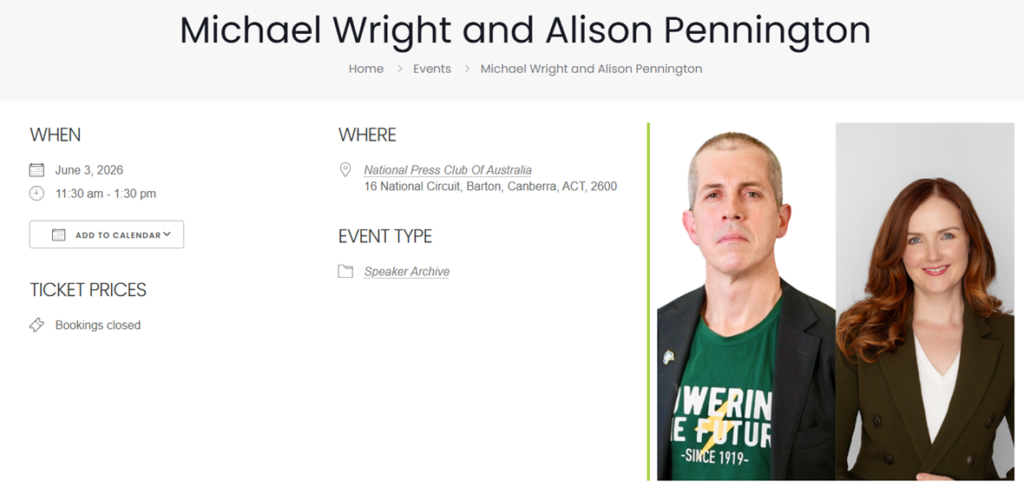
and McKell Institute Chief Economist Alison Pennington, which prompted the writing of this article.
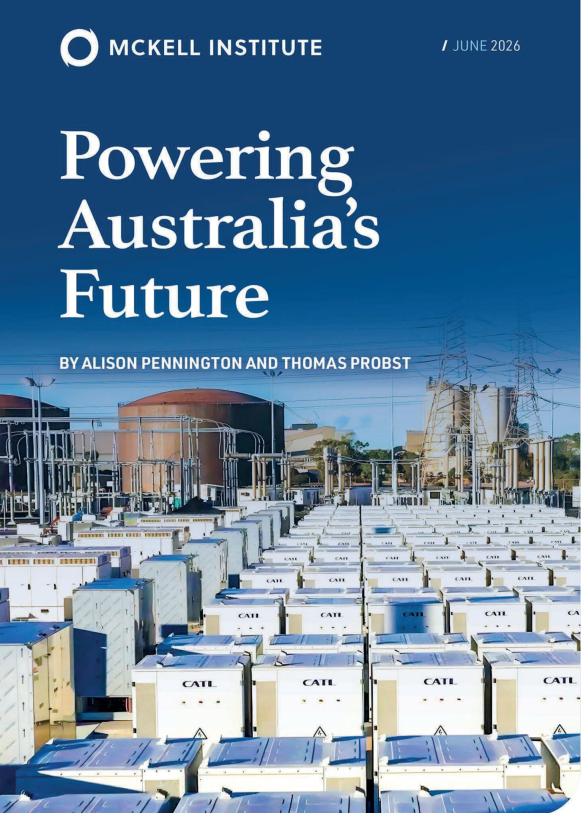
With an eye to the continuation of the Tomago aluminium smelter in NSW’s Hunter Valley, the McKell Institute and the Electrical Trades Union of Australia are promoting a bad idea: the formation of a government-owned renewable energy company, Sovereign Power. This is to develop, own, and operate renewable power facilities, funded off the government balance sheet. The aim is to sell power at favourable rates to high-energy users, including smelters, but not to data centres. Why the exclusion of the latter? The McKell Institute thinks the tech giants can afford to pay extra for their needs. This betrays a bias for the old industries ahead of the new.
The Federal government must reject this idea outright.
The arguments for it are flawed and expose the government to significant economic losses, are likely to drive up prices for domestic electricity customers and imperil private sector investment in renewable energy.
Tomago’s present owners, majority owned by Rio Tinto, can hardly believe their luck. Rio, who for years tried unsuccessfully to sell its uneconomic, global aluminium assets, including Tomago, is now relishing a public controversy about how much of a subsidy they should receive to ‘save’ Tomago. Their business model could end up being completely underwritten.
This article describes the problem and what should be considered. The author has no vested interest in any solution.
First, a brief note on the industry. There are three stages to aluminium: mining of bauxite ore, refining the ore to recover alumina and smelting alumina to produce aluminium. The last step is hugely energy intensive. Aluminium is sometimes referred to as ‘solid electricity’ owing to the large amount of power used in its production. Indeed, 14,000-16,000 kilowatt hours of electrical energy is needed to produce one tonne of aluminium.
Second, the Tomago story: In the late 1970s, my uncle David Easson, then head of the NSW Department of State Development, worked with NSW Premier Neville Wran to bring Pechiney, the French alumina company into the state, to set up with Australian partners and develop Tomago. Operations commenced in 1983.
Tomago is the country’s biggest aluminium smelter supporting thousands of direct and indirect jobs; it is a source of stable demand for the electricity grid; the plant regularly exports almost all its 590,000 tonnes of aluminium output, worth $2 billion a year.
Tomago’s energy needs, equivalent to 12% of total capacity in NSW, were twinned to the then state-owned and nearby Bayswater power plant, which sourced cheap coal from a state-owned coal mine. The Tomago-Bayswater power deal expires in 2028.
AGL Energy, which now owns Bayswater, sees the power plant as uneconomic; it is due to close by 2033 at the latest. Last October, Rio Tinto foreshadowed Tomago’s closure.
Hence the current spotlight on a looming challenge: no cheap coal-fired energy, and hence no Tomago. In January, Prime Minister Anthony Albanese visited the smelter and announced production credits for ‘green aluminium’. He was reported as saying “This is what a future made in Australia looks like.” So-called ‘green aluminium’ is smelted only using renewable energy. But it is far from certain in this case that this is possible for all of Tomago’s production any time soon.
Now in comes the McKell Institute to cloud the debate. The Institute styles itself as a progressive Australian public policy research organisation, with close ties to unions and the labour movement. In recent years it contests pro-market solutions.
McKell’s 2025 report, Securing Sovereign Capacity. Strengthening National Resilience in the Refined Metals Sector, claims that “acute market manipulation in the sector [is] being undertaken by China, as well as the challenges posed by global energy markets and industrial policy abroad… the Australian Government should consider a cohesive national strategy that ensures the sector doesn’t fail.” China dominates the international market and hosts the equivalent of 70-plus Tomagos, with smelters and potlines much newer and more efficient. From a global perspective, Tomago is old and uncompetitive.
Senator Tim Ayres, Minister for Industry and Innovation and Minister for Science, is canvassing a complex $300 million per year deal to save Tomago by subsidising power through the government-owned Snowy Hydro agency. This could be through a power-purchase agreement with Tomago to supply electricity at a stable price. He is seeking Commonwealth & NSW government joint funding support. It is not clear, though, that the NSW government is keen on this ‘solution’. Already, because of demands of industry and the growth in data centres, electricity supply is barely keeping up with retiring, unreliable and struggling coal plants.
A few weeks ago, Senator Ayres, spoke at a McKell Institute event on ‘Resilience and Statecraft in Science and Industrial Policy’ and piled pressure on the NSW government to come to the party. He said: “Reliable and affordable electricity is key to Australia’s industrial future.” And that “Australia should be a place where renewable energy powers aluminium smelting, which in turn produces renewable energy infrastructure.” He said of Tomago, “It’s a good asset and could have many productive years ahead.” But it needs an energy supply ‘fix’.
Instead of pursuing a variant of this approach, last Wednesday at the National Press Club Alison Pennington the Chief Economist of the McKell Institute and Socialist Left ETU National Secretary Michael Wright proposed a more radical option, the creation of government-owned, funded with government debt, ‘Sovereign Power’ entity. This is akin to the Soviet argument that if Woolworths, say, was funded with lower-cost government (sovereign) loans, grocery prices would be cheaper.
According to McKell ‘research’, access to government financing could translate to a power price as low as $66 per megawatt hour – about 44 per cent below an indicative, current market rate. As Sovereign Power is supposedly supporting a public-good, blue-collar jobs, and a ‘vital’ industry, McKell says Sovereign Power should not be required to earn a commercial return. Marghanita Johnson, ex-Rio employee, now Chief Executive Officer of the Australian Aluminium Council, predictably urges consideration of the ‘plan’. Rent seekers unite.
Tomago is in the Labor-held seat of Paterson. Job-losses would be hugely demoralising and feed the One Nation narrative that no one cares about ordinary Australians.
It is a wicked policy dilemma which highlights challenges of the clean energy transition and is key to the government’s ‘Future Made in Australia’ strategy. Any Tomago ‘solution’ requires careful cost-benefit analysis, including whether Australia, on ‘national resilience’ grounds, needs four major aluminium smelters in Tomago, NSW, Boyne Island, Queensland, Portland, Victoria, and Bell Bay, Tasmania. If government-subsidised energy is the answer, what is the question? Who bears the risk? Market solutions should be included in the policy mix. Sovereign Power is a catchy term. Pity the case is so weak and sketchy.
Naturally, Chris Bowen, the energy minister, is expected to say the proposal deserves careful study. The Federal ALP Conference is due to be held in Adelaide from 23-25 July and Wright is vowing to take his idea all the way to a binding-vote on the government.
There will be razzamatazz before the idea is buried.