
(2026) Catholic Education: Ideals and Realisation
Michael Lee, Director, Catholic Schools NSW, & Acting Chair, CER Ltd., Introduction:
Let’s bring all the people outside inside. Thank you for being so punctual. We’ll kick off proceedings. Can you hear me okay? Is that better? So good morning, everyone, and welcome to the 2026 CER Employment Law Symposium. My name’s Michael Lee. I’m not the judge. I’m the acting chair of CER Limited, and it’s my pleasure to welcome you to this Employment Law Symposium.
I’d like to acknowledge on stage with me is our first speaker, Dr. Michael Easson AM. And I see Peter Yates over there, the acting chief executive of Catholic Schools New South Wales. And later in the morning, we’ll be joined by Anna Dickinson, the new chair of Catholic Schools New South Wales. And the reason I’m speaking to you is I’m the acting chair of CER. So, before we begin today’s program, I’d like to take a moment to cover some safety information.
…I’d now like to acknowledge the traditional custodians of the land on which we gather today, the Gadigal people of the Eora Nation, and pay our respects to elders past, present, and emerging.
We recognise the rich heritage, wisdom, and ongoing contribution of First Nations peoples to Australian society and to our workplaces, communities, and institutions. As we commence this conference, may we be mindful of our shared responsibility to foster workplaces that respect the dignity of each person, promote justice, and strengthen our communities. Now, I’d like to ask you to join me in our prayer to commence proceedings this morning.
It’s the prayer of St. Joseph the Worker. So please join me in this room:
O glorious St. Joseph, model of all who are devoted to labour. Obtain for me the grace to work conscientiously, putting duty above personal inclinations, with gratitude and joy, and a spirit of penance for the remission of my sins. Help me to work with order, peace, moderation, and patience, without shrinking from weariness or difficulties, and with purity of intention and detachment from self.
May I always remember that in count I must render for time lost, talent wasted, and good neglected, all for Jesus, all through Mary, all after your example. O patriarch St. Joseph, amen.
Thank you very much. Hopefully, we all will be working with order, peace, and moderation here today. Today’s theme, “Wearing Every Hat”, reflects the reality facing leaders across Catholic education and Catholic organisations.
We’re asked to navigate legal obligations, workplace culture, governance responsibilities, staff well-being, industrial relations, emerging technologies, strategic leadership, and often all those things at the same time. So throughout today, we’ll hear from an outstanding group of speakers who will help us explore these challenges and provide practical insights we can take back to our organisations.
I should also mention that amongst you here this morning, we’ve got people who’ve come all the way from Tasmania and the Northern Territory. Thank you for those of you who’ve travelled so far to be with us. But to commence our symposium, it’s my pleasure to welcome Dr. Michael Easson. It’s a particular pleasure to welcome Michael to speak at the Catholic Employment Relations Symposium at this location.
And that’s because if you look across Lang Park, past Lang Park, you’ll see St. Patrick’s Church. And St. Patrick’s Church is the oldest surviving Catholic church in Australia. And one reason it’s there is that in 1836, Governor Richard Bourke abolished the status of the Anglican Church as the state church of New South Wales. Governor Bourke placed all religions on sort of an equal footing, and for government assistance to build churches and to run schools.
And Michael has written about Governor Bourke, and he might say more about Governor Bourke in his remarks. But Bourke did this just a few years after the Penal Laws were finally repealed in the British Parliament. Before those days, it was an offense to practice your religion if you were a Catholic. If you ran a Catholic school, you could be up for indefinite detention in jail. You weren’t allowed to run for Parliament if you were Catholic, and of course, until quite recently, you couldn’t become the sovereign of the United Kingdom if you were a Catholic or marry a Catholic. Thankfully, those rules have been overturned.
I first met Michael at a Young Labor conference when we were both active in the Labor Party in the Sutherland Shire many years ago, and we were later both students at the University of New South Wales doing good things. Michael went on to serve as the Secretary of the Labor Council of New South Wales, commonly known now as Unions New South Wales. He was also vice president of the ACTU.
He played a very important role when the Greiner government was elected and John Fahey was the Minister for Industrial Relations, and certain proposed changes came from the government, and Michael and John Fahey were able to negotiate some compromises that benefited both sides. So that was quite an achievement. Michael’s now quite the Renaissance man. Having reached the peak of service in the trade unions, he returned to study to broaden his skills several times and has had a spectacular career in business, some of which is noted in the program today.
Michael is the co-founding director and executive chairman of EG Funds, and brings extensive experience across infrastructure, funds management, governance, and public policy. He was appointed a member of the Order of Australia and has served in numerous senior leadership and board roles throughout his distinguished career. I understand he also served on the New South Wales Secondary Schools Board and the Board of Senior Schools Studies, as well as being an adjunct professor at the Australian Graduate School of Management.
With all of that, I’m sure we’re all keen to hear what Michael has to say this morning. Please join me in welcoming Dr. Michael Easson.
Michael Easson:
Thank you very much, Michael. I worry when someone begins a conference saying a prayer before I get up to speak. But hopefully it won’t be too bad. Governor Bourke, as Michael mentioned, is one of my heroes whom one day I hope to write a book about. There’s a great statue outside the Mitchell Library or the State Library, not too far away from this venue. There’s an astonishing scroll/plaque about all the things that Bourke did for the colony 1831-37 when he was Governor.
He dis-established the Church of England. He provided scholarships for kids to be educated at Catholic and non-state schools. He was an incredible reformer. He’s someone not only responsible for St Patricks, but for levelling prejudices and ensuring that religious tolerance and equanimity occurred in our society. I’m a fan.
I suspect there’s one thing that unites everyone here today, and that is that no child ever born is unimportant, that every person matters.
Today, there’s a lot of nitty-gritty issues to get through. But I’d like to begin by reflecting on why the “Catholic” matters in education.
Here’s a quote from Dr. Rita Pearson, who did one of the first TED Talks on education:
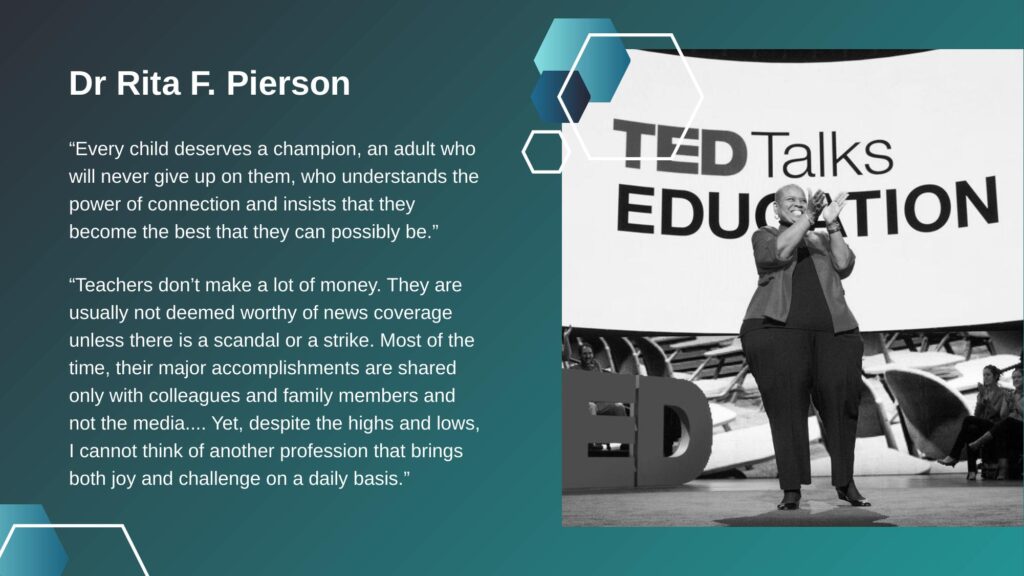
She highlights there in those quotes that every child deserves a champion, and teachers are those champions of individual kids. She remarks that teachers aren’t incredibly well-paid compared to many, but what a challenge it is to inspire, to lead kids, and to ensure that you can inspire them to do better in their lives. What a satisfying and joyful career it is to be a teacher.
I know Sidney Hook once made the comment, looking back on his life, that people tend to remember the teachers they have rather than the methods that they experienced in education.
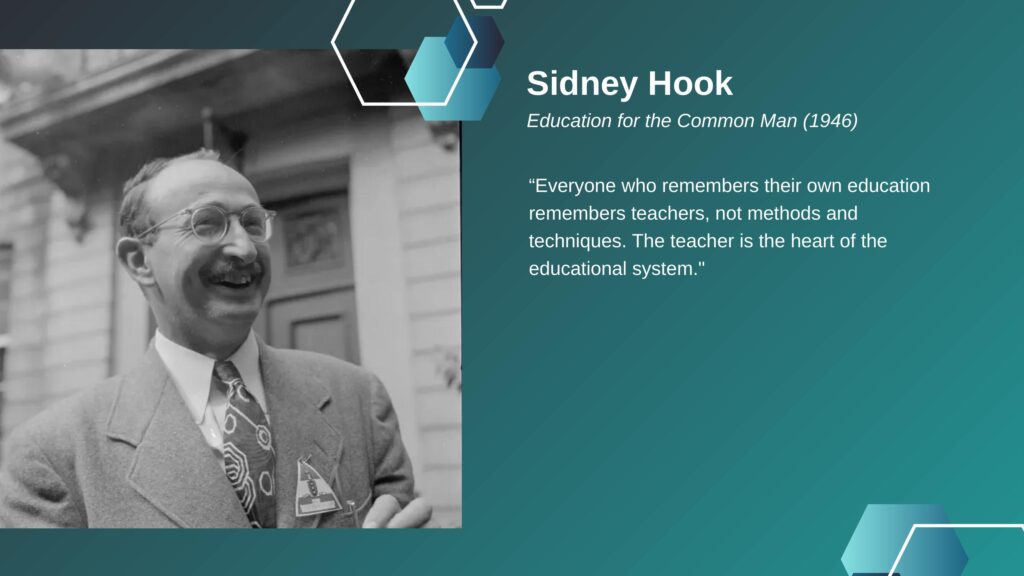
That’s the point of that slide. It highlights the great calling it is to be an educator.
G.K. Chesterton, who’s a famous person in Catholic theology and apologetics – perhaps now more famous for the Father Brown mystery stories on TV – had a great line that education is only truth in a state of transmission.
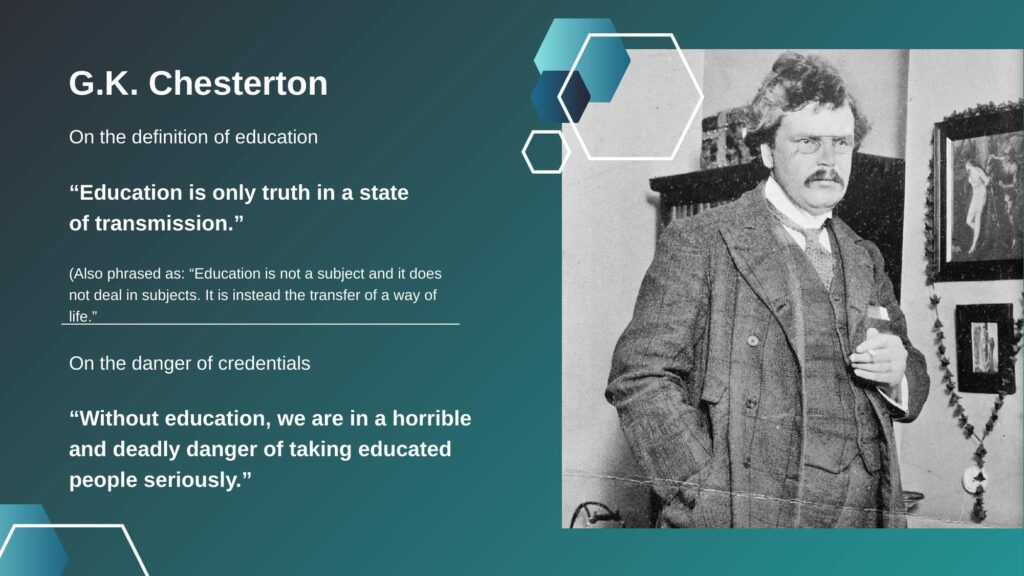
In other words, he’s saying we’re imparting the wisdom of the past, the insights that come from that in the present. He has a witty line. He was a great person for paradox, and he says that without education, we’re in a horrible and deadly danger of taking educated people seriously. In other words, we all must be educated and thoughtful so we can see through the cant that might sometimes crop up in someone we meet or what we hear.
To be educated is to be thoughtful, to develop your own convictions, and that’s something important.
Now, Albert Shanker is a person I’ve admired. He was a leader of the American Federation of Teachers, and he was a courageous person who published every fortnight an article in The New York Times and every month in The New Republic. Most of his articles covered education. He was a thoughtful, innovative leader in the education field.
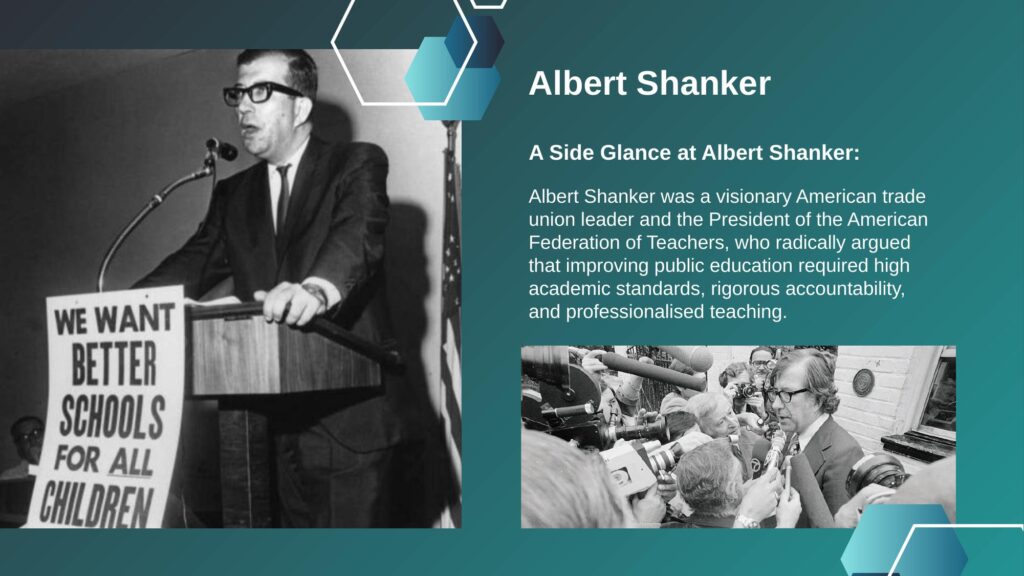
Shanker believed that unionists should not leave education to the so-called professionals, that they had a role as well in putting forward ideas. Amongst the very interesting ideas that he had were about tough love and standards. He believed that they were important for the credibility of teachers, for the credibility of the education system. He believed that teacher professionalism and quality had to be constantly improved, and that was a responsibility of everyone in the education system.
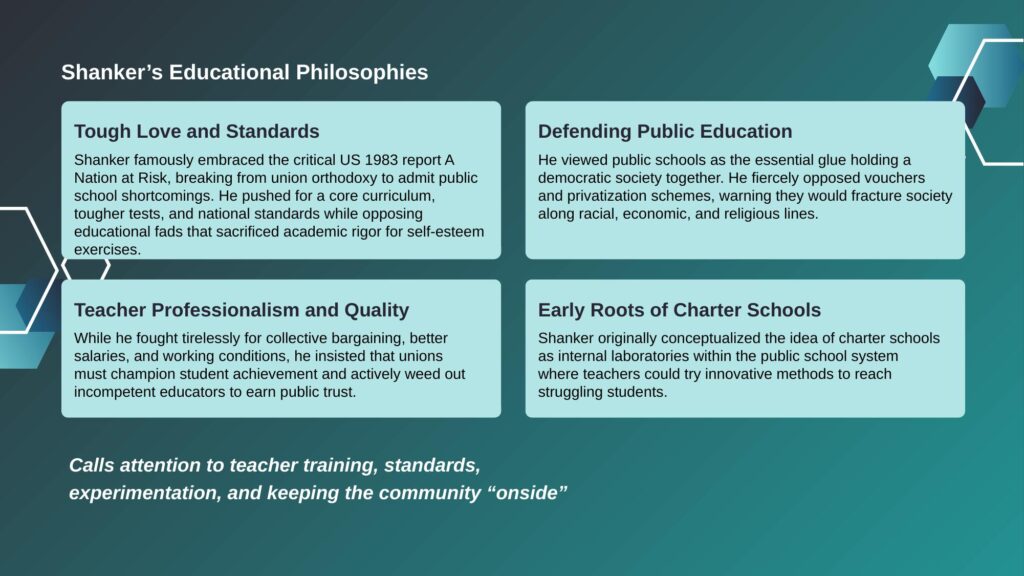
Coming from America, he strongly defended public education. But when you think about the Catholic schools in our country, Catholic schools educate everyone, not only Catholic kids. I think we educate one in five Australian children in about 1,755 Catholic schools across the country. An incredible achievement. Thank you to Sir Henry Parkes and the anti-Catholic bigots for kicking us in the nineteenth century to do something to preserve our faith. The mix of kids that we educate is astonishing.
Shanker also argued, even, for charter schools in the American system. He proposed that people shouldn’t be afraid of experimentation. That’s a rare example of a union leader who was innovative, thinking hard, even challenging his own friends and compatriots in that organisation, the American Federation of Teachers, to think laterally about what experimentation might be best for encouraging good outcomes for children. So, that’s a sideways glance at Albert Shanker. He proposed ideas that I think are relevant today.
Leszek Kolakowski is one of those people who most people haven’t heard of, but I know that Pope Benedict used to quote him, and he was a good friend of John Paul II.
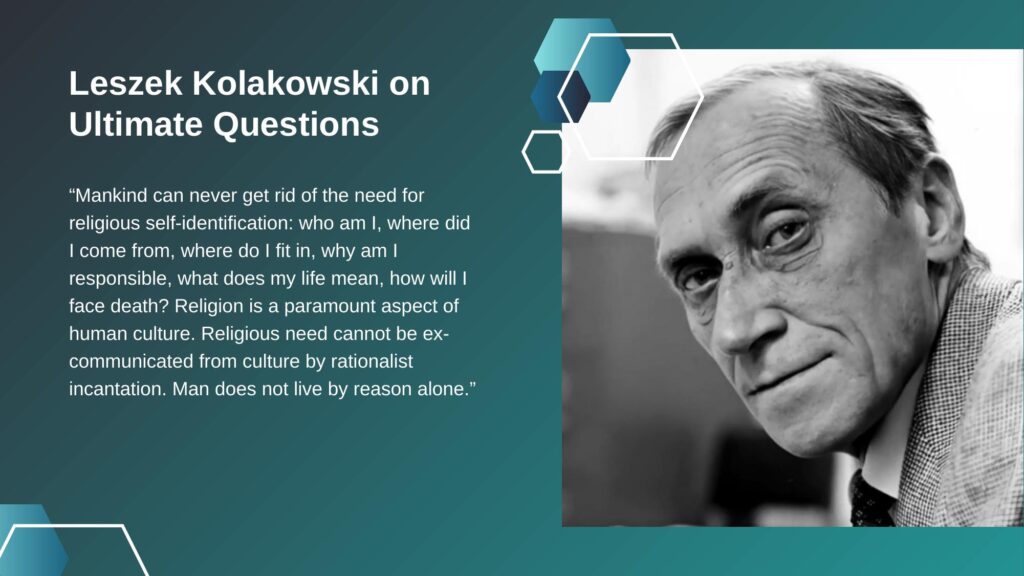
He was a Polish émigré who escaped communist Poland; he was incredibly thoughtful and provocative. He was a philosopher who ended his days in Oxford. He had this line: “Mankind can never get rid of the need for religious self-identification. Who am I? Where did I come from? Where do I fit in? Why am I responsible? What does my life mean? How will I face death? Religion is a paramount aspect of human culture. Religious need cannot be excommunicated from culture by rationalist incantation. Man does not live by reason alone.”
He’s saying the great questions are hugely relevant to the education of anyone, and it’s vitally relevant to Catholic schools.
What I’m highlighting here is that today we’re going to be diving into workplace agreements, how we can do better in the employment system, in encouraging the better education of ourselves and the whole profession. What matters fundamentally is what we stand for and what we’re trying to inculcate in our kids.
Now, recently, I attended the AMA conference in Melbourne, the Australian Medical Association conference.
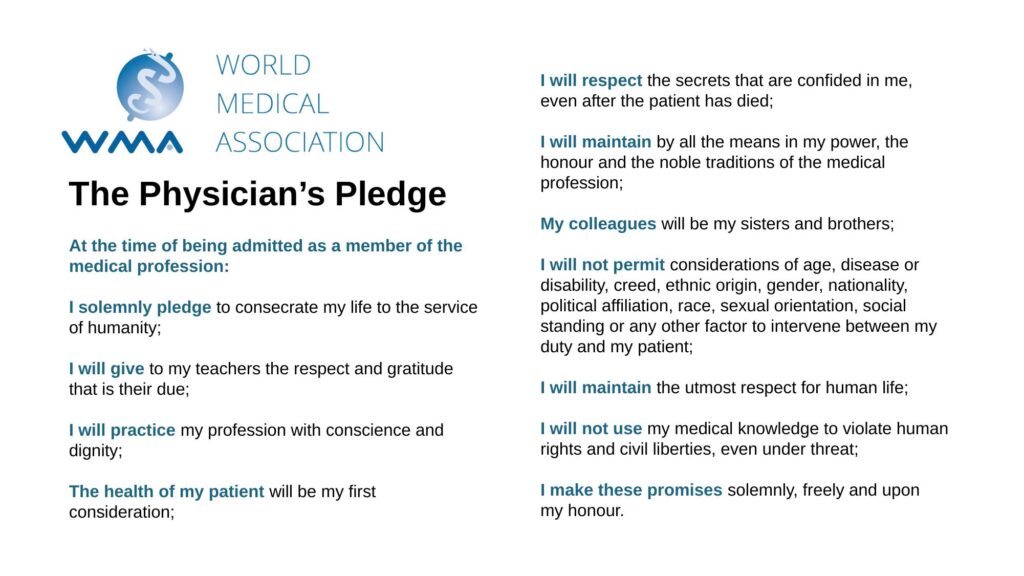
I found it interesting that everyone stood up. They didn’t say a prayer, the prayer of St. Joseph the Worker. They said this pledge, which is on the screen, a pledge which replaces the Hippocratic Oath. If you read it, I think it’s a very interesting summation of what it means to be a doctor. “I solemnly pledge to consecrate my life to the service of humanity.” Almost a religious expression to say that with those words. “I will give to my teachers the respect and gratitude that is their due. I will practice my profession with conscience and dignity. The health of my patient will be my first consideration,” et cetera.
That sort of pledge as to what the medical profession stands for suggests similar for the business/profession of education. What is highlighted here is an example of something that maybe we can draw from. The experiences and the inspirations of other professions can be relevant to our own.
I know that various school systems in Australia have tried to adopt charters.
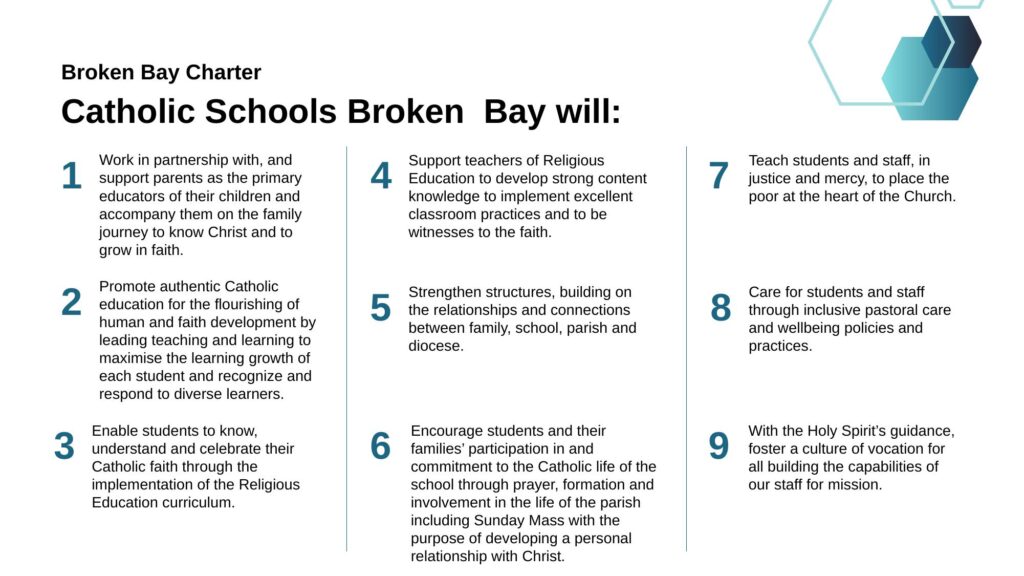
This is an example of Broken Bay where, to highlight the first point, the claim is made to “work in partnership with and support parents as the primary educators of their children and accompany them on the family journey to know Christ and to grow in faith.”
You can read the rest of that on the screen. It’s an attempt by the diocese in Broken Bay, not far away from us, across the Bridge, to try and think about what it means to be developing and imparting Catholic ideas in education. I had a look at other charters, and there was one in Hobart, and I guess there are people from Tasmania here, as I heard earlier. Bishop Porteous issued a very long document, which I couldn’t- summarise here.
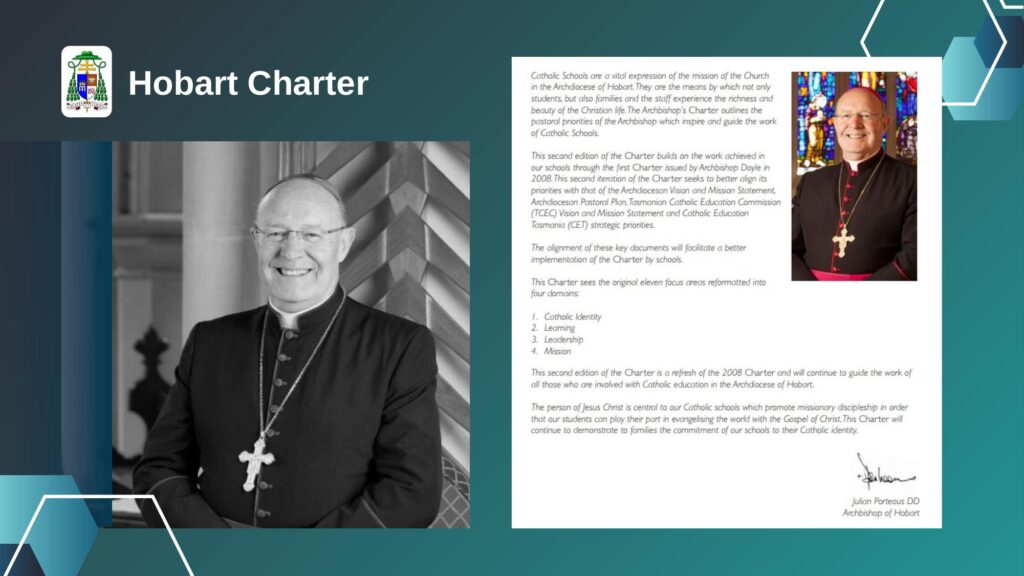
I didn’t dare go to ChatGPT to try and do a summary. But it’s a very eloquent statement of what Catholic education means, and I recommend it to anyone who’d like to deep-dive into that subject.
Now, in thinking about today’s topic, I thought that Pope Leo XIV’s Drawing New Maps of Hope, the writing that he released in October last year, which celebrated the 50th anniversary of a document issued during Vatican II, Gravissimum Educationis, is relevant to what we can talk about.
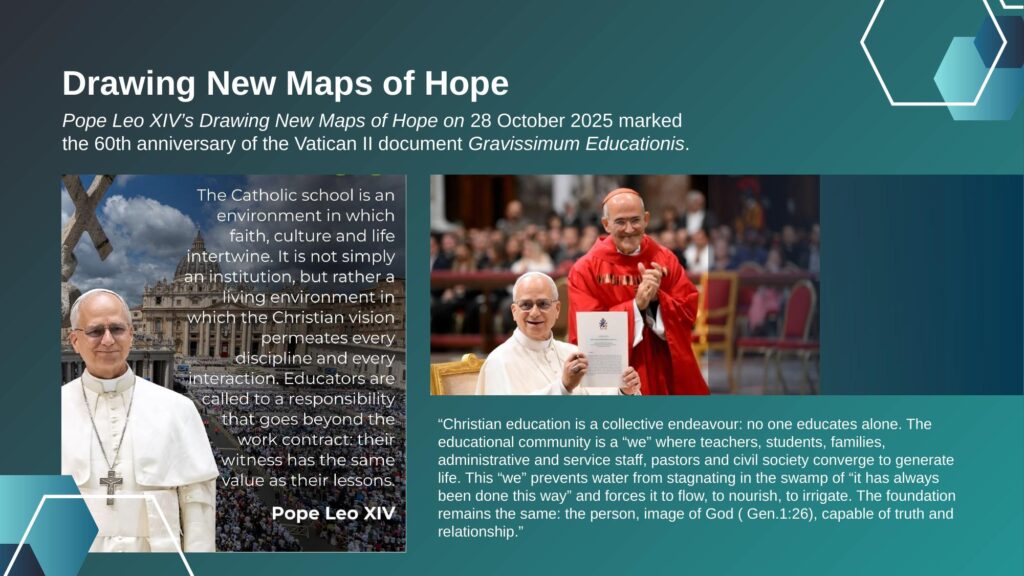
He writes: “Christian education is a collective endeavour. No one educates alone. The educational community is a “we”, where teachers, students, families, administrative and service staff, pastors, and civil society converge to generate life. This “we” prevents water from stagnating in the swamp of “it’s always been done this way” and forces it to flow, to nourish, to irrigate. The foundation remains the same: the person, the image of God, capable of truth and relationship.” That is a profound exposition of education philosophy and what it means to believe in the Catholic version of that.
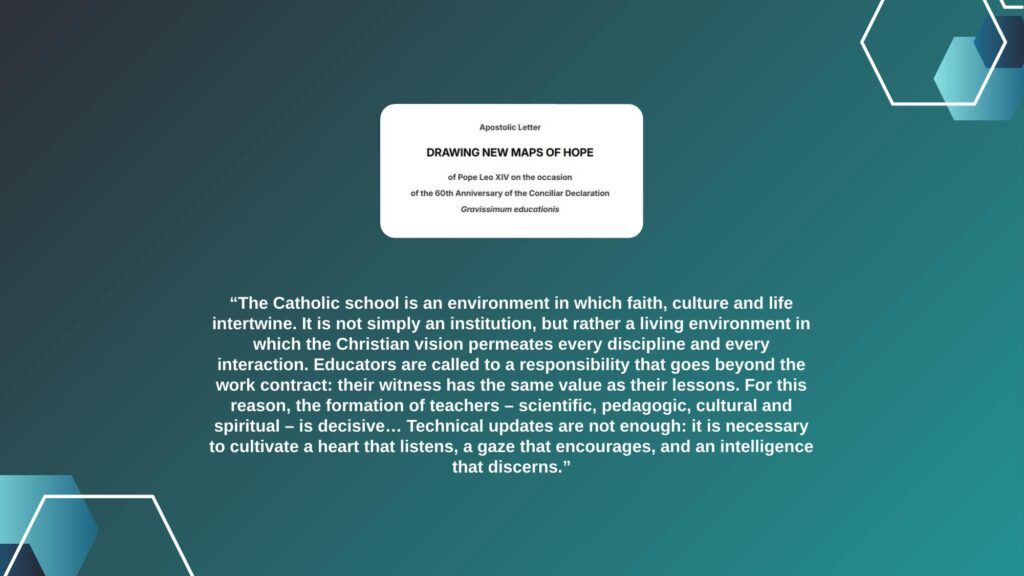
A lot of what he wrote in that Apostolic Letter is relevant to us, today. What we’re striving to do, what is the purpose ultimately of everyone in this room in being involved in the education system? “The Catholic school is an environment in which faith, culture, and life intertwine. It is not simply an institution. It’s a living environment.” Perhaps that quote there summarises what we all believe in.
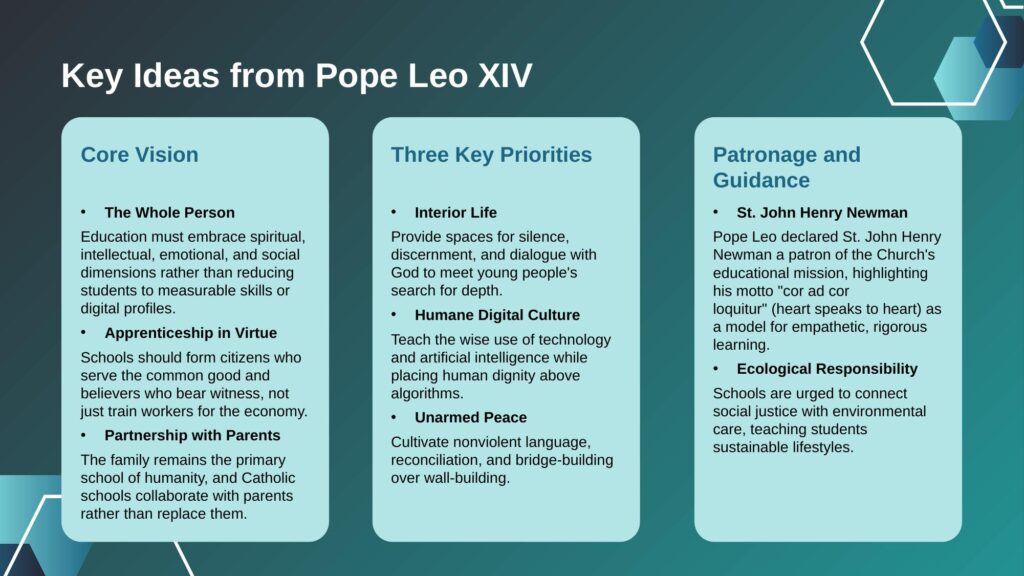
I did use a summary. The core vision covers the whole person, the idea that all of us are called to an apprenticeship in virtue, a partnership with parents. That core vision is what Catholic education stands for. There are three priorities associated with that. The interior life of the person, including providing space for silence, discernment, and dialogue with God to meet young people’s search for depth.
Humane digital culture is mentioned. Our Pope is a modern man, the first scientist ever to become pope, and he’s saying the wise use of technology and artificial intelligence must place human dignity above any algorithm. Unarmed peace: Cultivate a non-violent language, reconciliation, and bridge-building over wall-building. And he highlights the prayerful patronage that comes from, say, St. John Henry Newman, the great English convert and Catholic, who wrote extensively on education. He is a model and an inspiration for Catholic education thinking.
Pope Leo also highlights, interestingly in this document, ecological responsibility. Schools are urged to connect social justice with environmental care, teaching students a sustainable lifestyle. It’s a very modern document, and I urge everyone to have a look at this guidance from Pope Leo XIV.
Now, Mary MacKillop is our first Australian saint, and here’s a number of statements there that she is famous for.
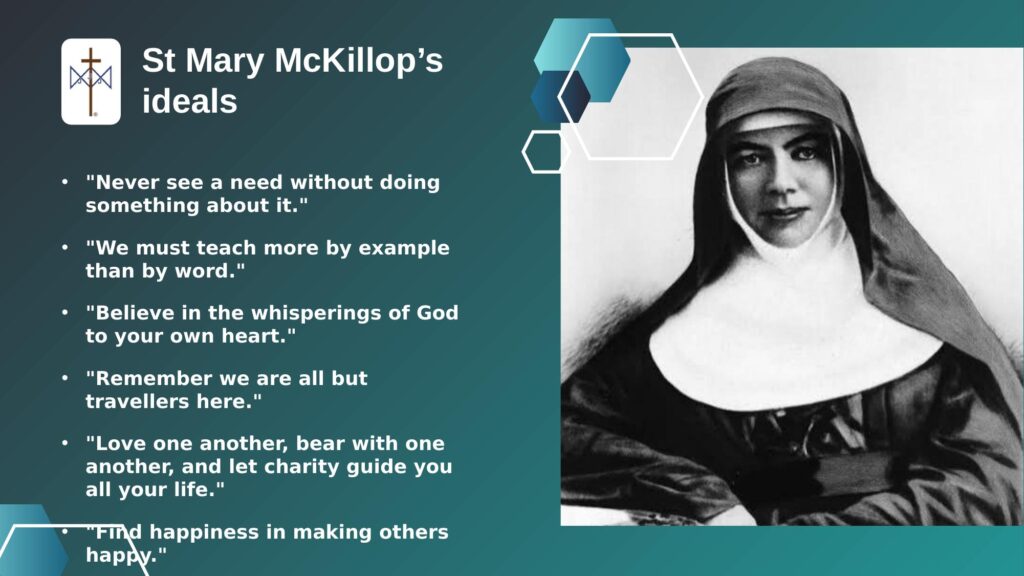
Never walk away from a need that you see, address it. I hope that all the kids that we’re privileged to educate might be able to think about these principles in their life. We must teach more by example than by word. Believe in the whisperings of God to your own heart. Remember, we are all but travellers here. And find happiness in making others happy. Love one another, bear with one another, and let charity guide you all your life. Wonderful principles that are meant to be lived, not merely rote repeated.
Those principles I hope every kid that goes through Catholic education hears, and believes in, and reflects on.
Now, in preparing for today, I contacted a fellow called Chris Ewing, who’s based in the United States, and he’s preparing a major document on Call to Lead about Catholic principles and education.
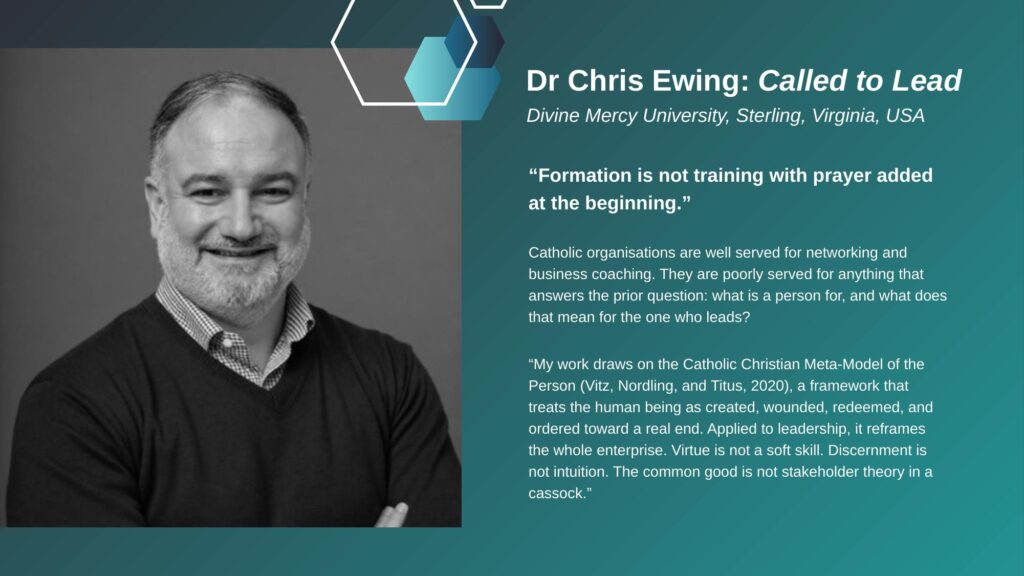
He argues that formation is not training with prayer added at the beginning. It’s a reflective engagement throughout one’s whole life in becoming a better person and a better teacher “Catholic organisations are well served by networking and business coaching. They are poorly served for anything that answers the prior question: What is a person for, and what does that mean for one who leads?” He highlights his inspiration from Catholic thinking, and argues, “Discernment is not intuition. The common good is not stakeholder theory in a cassock.” He is saying, let us think harder about what it means to educate ourselves and the teachers in our system and the kids in our care.
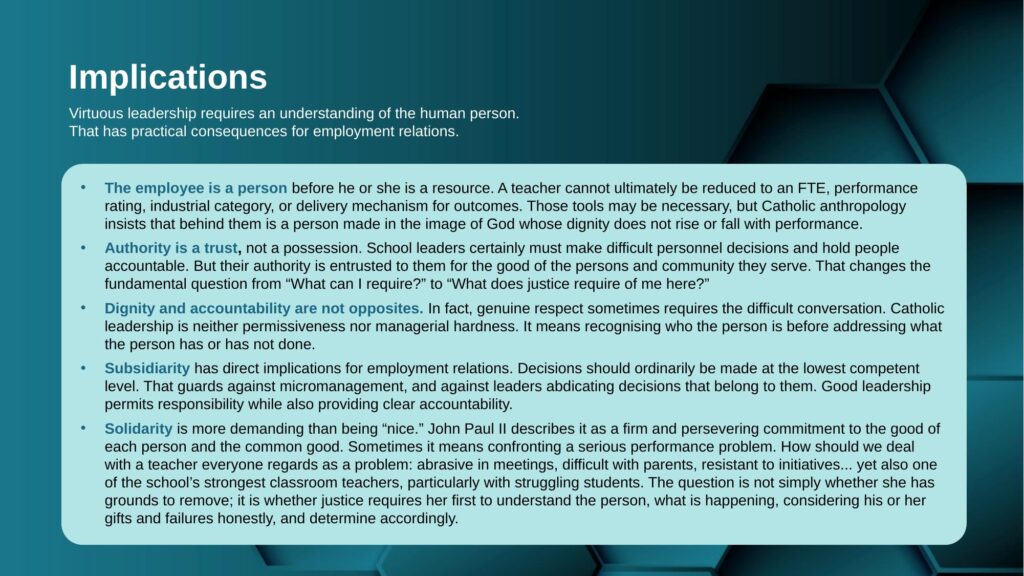
What does all this mean? I think these are some points that I gleaned from reading some of these inspirational quotes and excerpts from different Catholic religious documents.
The employee is a person before he or she is a resource. A teacher cannot ultimately be reduced to a full-time employee performance rating, industrial category or delivery mechanism for outcome. It’s (also) something more.
It’s highlighted here in this slide. Authority is a trust, not a position. School leaders certainly must make difficult personnel decisions and hold people accountable, but their authority is entrusted in them for the good of the persons and the community they serve. Dignity and accountability are not opposite. Subsidiarity has direct implications for employment relations, as is highlighted here, and solidarity is more demanding than being nice.
It’s a robust set of concepts. These summary points here are the implications I draw from the high philosophical and thoughtful statements I’ve referred to earlier.
In conclusion, I see that Catholic employment relations should be concerned not only with managing performance, rights, obligations, and risks, but with exercising authority in a way that recognises the dignity, moral agency, vocation, and potential flourishing of every person entrusted in the institution.
Thank you for the opportunity to provoke a little bit of thinking this early in the morning. I appreciate everyone’s attention. Thank you.