
The Spanish Civil War has troubled me since I was 19. I read George Orwell then, appreciated his critique of the war, his 1937 essay ‘Spilling the Spanish Beans’ and book-length Homage to Catalonia (1938). I thought Orwell admirable in taking up arms in Spain from late December 1936 to June 1937. The cause of defending decency (one of Orwell’s favourite words) from fascism seemed an overwhelming principled position.
The uninviting paradox, however, was that one side was led by a ruthless, murderous authoritarian (Franco) and the other was in the throes of being smothered by ruthless, murderous Soviet regime operatives. Orwell was shot in the neck by one of Franco’s snipers and fled Spain knowing the Reds wanted him dead.
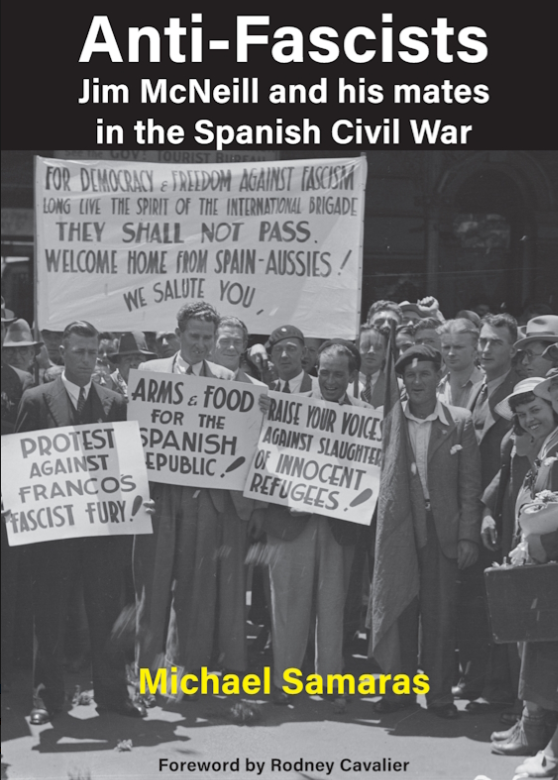
Michael Samaras’ book Anti-Fascists. Jim McNeill and his Mates in the Spanish Civil War (Connor Court 2025) is a reminder of that interminable question: whose side are you on? To answer that question some quick background is necessary for readers unfamiliar with Spain 90 years ago.
In February 1936 the Spanish Popular Front government, a coalition of the left, narrowly defeated a coalition of the right in democratic elections. The civil war erupted on 17 July 1936 when right wing generals Emilio Mola and Francisco Franco launched an armed uprising aimed at overthrowing Spain’s government.
Both sides – the government loyalists (Republicans), and the opposition insurgents (Franco’s Nationalists) – sought and obtained foreign military aid. Thanks to Nazi Germany’s and Fascist Italy’s military assistance, Franco airlifted troops from Spanish Morocco to the mainland to bolster capacity. In three years of ferocious conflict, the tide turned in favour of the insurgents.
Around 5,000 German air force personnel in the Condor Legion carried out aerial bombings for Franco. These bombings included German and Italian aircraft levelling the Basque town of Gernike (Guernica in Spanish), commemorated in Picasso’s famous painting. The Italians sent 75,000 troops to Spain. The country became a laboratory for contesting ideologies and weaponry under battlefield conditions, a precursor to the Second World War.
The Soviet Union dispatched military advisers, tanks, aircraft, and other war materiel to Spain. Between 1936 and 1938, between 35,000 to 40,000 volunteers from more than 50 countries joined the International Brigades to defend the Republic. They were communist-led and controlled. A smaller number of international recruits joined the Nationalist forces.
In September 1938, during the major Battle of the Ebro, named after a river which flows through Catalonia, the Spanish Republican Government demanded disbandment of the International Brigades. This action was meant to demonstrate the government was moving away from Soviet influence and to persuade France and Britain to end their arms embargo on the Republic. Both governments maintained aloof neutrality and no arms came.
The Spanish Civil War was a story of summary executions, arbitrary meting out of justice and mass atrocities carried out by bloodily eager belligerents. Around 500,000 deaths occurred from all causes, including by way of combat, execution, bombing, and malnutrition. At least as many were driven into exile. The bloodshed and bitterness were appalling.
In the first year of the war, almost 7,000 Catholic priests, monks, and nuns were murdered by Spanish revolutionaries and anarchists. Thereafter the slaughter of priests by Leftist radicals considerably diminished. Franco, too, though in smaller numbers, executed religious-order members sympathetic to democratic Spain.
Catholic revulsion to church-burning fanatics is understandable. Whatever good those torchers strove to do had to be judged in its entirety. Spanish anarchists made good versus evil in Spain ludicrously simplistic and unconvincing.
My thinking is influenced by a good friend, Michael McLeod, onetime ACTU International Officer, who learnt Spanish, won the University Medal upon graduation, and wrote about the Spanish anarchists and the English historians. He began sympathetic to the former. His hypothesis was to indict many of the latter, surmising that the lack of language and cultural familiarity with Spanish, including source documents and original material, precluded their serious understanding of Iberian political movements in the period leading to the civil war.
The absence of plausible accounts for the Spanish movement’s exceptional persistence into the 1930s, drove Michael forward. As he sifted through the material, in Spain and other locations, he concluded there was something correct about the conventional English analysis. There was a thread of insanity about the Spanish syndicalists and revolutionaries.
There are numerous histories of the conflict. Hugh Thomas’ The Spanish Civil War (1961 & subsequent revisions and enlargements in 1965, 1977 & 2001) and Antony Beevor’s The Battle for Spain. The Spanish Civil War 1936-1939 (1982; revised, 2006) are unbeaten for scholarship and cool-headed assessment.
Besides Orwell, Franz Borkenau’s The Spanish Cockpit (1937); Ronald Radosh, Mary Habeck & Grigory Sevostianov, editors, Spain Betrayed. The Soviet Union in the Spanish Civil War (2001); Paul Preston, A Concise History of the Spanish Civil War (1996); and Preston’s ‘Perfidious Albion’ – Britain and the Spanish Civil War (2024) add important perspectives. From an Australian perspective, there is Amirah Inglis’ pioneering research, Australians in the Spanish Civil War (1987).
Spain in the 1930s had impacts and ripples Down Under. The Catholic Church was traumatised by understanding that in parts of Spain the most dangerous occupation was that of a priest celebrating Mass, holding aloft the holy Host. In Sydney’s Catholic Freeman’s Journal, an editorial declared “the Nationalists under Franco are fighting for Christian civilisation in Spain against that fanatical and godless Communism which Russia has vowed to spread over the universe.” (29 October 1936.) Samaras wrote “many of the volunteers were puzzled by the anti-clericalism”, but he quotes others explaining the reactionary outlook of the Church.
During the Spanish anti-clerical carnage, at Melbourne University in March 1937, a thousand people turned up for a debate on the motion: ‘The Spanish government is the ruin of Spain”. The Campion Society supporters, including the 21-year-old Bob Santamaria, shouted in ferivino “Long live Christ the King!” Most regarded themselves as Catholic Labor.
The ALP divided on the issue with most supporting neutrality. Samaras wrote that Labor Leader John Curtin “is not known to have ever specifically commented on [the war]”, but he did, both directly and indirectly. For example, in June 1937, in Melbourne’s The Age newspaper, referring to the ALP’s attitude to the Spanish civil war, Curtin said “Australia had neither the capacity nor the resources to act as a police force or a salvage corps in Europe. The best contribution Australia could make to the peace of the world was to look after the Australian people and give no provocation to other countries” (16 June 1937). This was a cynical and unprincipled viewpoint but one that kept the party united.
Interestingly the President of the NSW Branch of Chifley’s Labor Party, J.A. McCallum, a Presbyterian, was appalled by how the Catholic Church influenced Labor’s neutral stance on the Spanish Civil War. McCallum was Federal Labor’s unsuccessful candidate in 1934 in the Martin by-election after the death of W.A. Holman. He was troubled by the threats posed by Japan and the European dictators and let his ALP membership lapse. He wrote a pamphlet Hitler and the Trade Unions (1940) warning unions of the fascist threat. In 1949, he was elected a Liberal Senator for NSW.
Radical leftists and communists in Australia thought differently to the mainstream about Spain. Hence the Samaras book and its insights into Jim McNeill (1900-1976), ironworker, labourer, and dedicated communist, and his friends including his best mate, Ted Dickinson, who died in Spain. Between 65 and 70 Australians volunteered to fight for the Republican side. At least 16 died there. As Samaras notes, at first in Australia the Spanish Relief Committee was formed “to raise funds to send a Red Cross unit to Spain.” Then the call went out for fighting volunteers.
McNeill, in joining the effort in Spain, was no innocent in the developing contest for control of the left there. Samaras observes: “The International Brigades ha[d] a dual military and political command structure, modelled on the USSR’s Red Army.” Political commissars ruled as much as their officers. Samaras argues: “As internationalists, they straightforwardly comprehended the war as part of the global struggle against fascism” and, he might have added, the leading role of the Party. Samaras notes that in Barcelona, “a struggle was fought out between competing elements of the anti-fascist coalition.” This was decided not by way of an arm wrestle in the hall of the local CNT (Confederación Nacional del Trabajo, the trade union confederation). Guns and grenades decided matters between what Samaras genteelly calls the “competing elements”.
McNeill was injured in July 1938, saw battle again in August and September, and was shot in the leg and buttock at the Ebro battle on the last day the Brigades fought. He recovered from his injuries in Spain, then France, and then returned to Australia.
When the Second World War broke out, McNeill volunteered to fight the Nazis, contrary to the CPA’s position of neutrality, given the Soviet Union-Nazi Germany alliance.
In Homage to Catalonia, Orwell wrote: “As a militiaman one was a soldier against Franco, but one was also a pawn in an enormous struggle that was being fought out between two political theories. When I scrounged for firewood on the mountainside and wondered whether this was really a war or whether the News Chronicle [an anti-Franco English newspaper] had made it up, when I dodged the Communist machine-guns in the Barcelona riots, when I finally fled from Spain with the police one jump behind me—all these things happened to me in that particular way because I was serving in the POUM [Partido Obrero de Unificación Marxista] militia and not in the PSUC [Partido Socialista Unificado de Cataluña – the Unified Socialist Party of Catalonia]. So great is the difference between two sets of initials!”
The PSUC was the fusion of various Marxist parties, including the Catalan Communist Party. By the time Orwell arrived in Catalonia it was under communist control and affiliated to the Comintern, the Third International. The POUM were anti-Stalinist socialists, many ex-communists, partly derived from the former Workers’ and Peasants’ Bloc. The POUM had almost no influence outside of Catalonia. The PSUC version of a ‘united front’ was a model not replicated elsewhere in Spain, where the Socialists mostly kept some distance from the Stalinists.
My readings have convinced me that Orwell did not understand many details of the intricate politics and conflicts when he was in Spain but the broad sweep he got right. Scholarship now highlights that the POUM, with Spanish characteristics, was Nikolai Bukharin-influenced, more than Trotskyist. I came to see Orwell’s sneering contempt for Catholics as a peculiarly English affliction.
This background calls attention to the opening quotation in Samaras’ book. It is taken from Orwell’s review published in late July 1937 of two books, Borkenau’s The Spanish Cockpit and John Sommerfield’s Volunteers in Spain. Towards the end of his piece, Orwell writes: “Volunteers in Spain is the record of his [Sommerfield’s] experiences. Seeing that the International Brigade is in some sense fighting for all of us – a thin line of suffering and often ill-armed human beings standing between barbarism and at least comparative decency – it may seem ungracious to say that this book is a piece of sentimental tripe.”
The italicised words are the quote at the front of Samaras’ book. Orwell’s reference to the International Brigade is laced with irony. It is not the gushing praise which Samaras implies. In the same review Orwell wrote “the Communists were using every possible method, fair and foul, to stamp out what was left of the revolution.”
Orwell concluded: “When I left Spain in late June [1937] the atmosphere in Barcelona, what with the ceaseless arrests, the censored newspapers and the prowling hordes of armed police, was like a nightmare.” I believe the quotation snipped from Orwell is misleading. This is the problem with “quilt quotes” words assembled out of context to purport a different meaning.
In December 1936, the month Orwell arrived in Spain, the POUM was expelled from the Catalan government at the behest of the communists and was deemed a pro-fascist party. Spanish Trotskyists, independent socialists, and communist critics, where effective and popular, were hunted and killed by the NKVD (Soviet secret police) operatives, the International Brigadiers, and their dupes. Unhinged paranoia ran deep. The 1936-37 Moscow Trials had “revealed” veteran Bolsheviks Bukharin and Trotsky were Gestapo spies.
Borkenau on his second visit to Spain was arrested by the NKVD. This led to his searing indictment of the communists’ determination to suppress dissent and install totalitarian methods. The eye-witness accounts of Orwell, Borkenau, and others such as Gerald Brenan’s The Spanish Labyrinth (1943) beg consideration of what admired International Brigadiers, including McNeill and Dickinson, were up to. After all, those Australians were in Catalonia. The tension between the ideal of defenders of freedom and homicidal pawns of the Comintern is the nub of the matter.
Samaras’ writing on the Australians in Spain is clear, his arguments rely on evidence from extensive mining of archives, wide reading, references to original source material and searches of contemporary newspapers. He brings to life not only McNeill, the hero of Samaras’ account, but also other comrades, many largely forgotten. Their stories merited the telling but there should have been more space for discussion of the dilemmas they faced.
To make sense of McNeill, his undoubted bravery in 1938 and at the outbreak of the Second World War, Samaras presents him as the principled anti-fascist, the simple, noble man. Samaras skirts over the moral issues and challenges posed by the methods and practice of creeping Soviet communist control in Catalonia and elsewhere in Spain.
What did McNeill think about the shifts in the 1930s from communist propaganda condemning social democrats as ‘social fascists’ to united front tactics, ‘no enemies on the left’ in the middle 1930s. What did he think of the implications of the Molotov-Ribbentrop Pact, high Stalinism, Khrushchev’s revelation of the hoax of the Moscow trials, the crushing of uprisings in Poland and Hungary in the 1950s and elsewhere and die-hard support for Ernie Thornton’s thugs in the Federated Ironworkers Association?
It is as if McNeill is sanctified for anti-fascism, seemingly lobotomised thereafter, then glorified for his support of the Aaron brothers, the leaders of the CPA, in their dissent against the Soviet invasion of Czechoslovakia in 1968.
I was and am divided about the romanticism of Orwell’s quest to defend the Republic as an independent socialist, and the fear that a totalitarian communist state might have emerged under Moscow tutelage. That is no defence of Franco, a boorish, brutal dictator who besmirched his nation. Nuance and paradox are at the heart of my discomfort. Samaras’ book, which I admire for its strengths, would have been stronger if more attention was given to those features of the Spanish cockpit, as Orwell and Borkenau called the struggle.
Editor’s Note: Michael Easson was instrumental in Michael Samaras’ book finding a publisher. He was asked to read the manuscript when it was under consideration by the publisher, Anthony Cappello, of Connor Court Publishing. He recommended it be published.